The Goddess of Mercy
The story of Minnie Vautrin
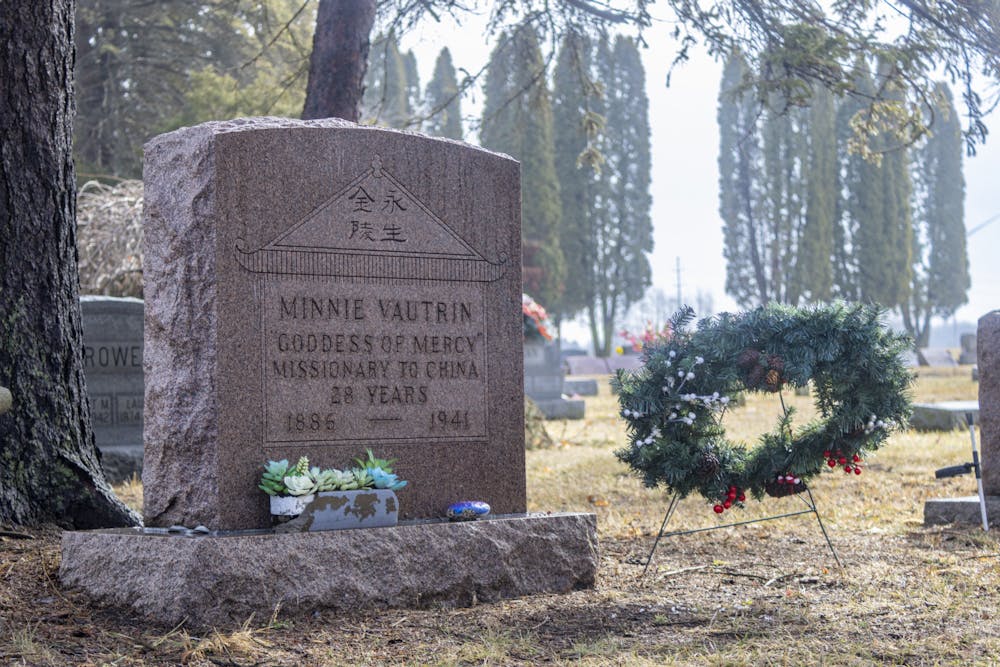
Salt River Cemetery is the final resting place for over 5,000 people and is located just outside the village of Shepherd. In this small, quiet cemetery lies Wilhelmina “Minnie” Vautrin, an educator and American missionary.
Born in 1886, Minnie acquired several titles before her death in 1941. Many called her their teacher or professor, but to the thousands of women she protected at Ginling College in China during the 1937 massacre in Nanjing (formerly Nanking), she is known as the “Goddess of Mercy.”
The Midwest native spent a major part of her life educating students in China. At the beginning of the Second Sino-Japanese War, Minnie kept diaries of her experiences overseas, as Japan invaded the country.


Her records would later help historians understand what some call the “Rape of Nanking.” A massacre that took the lives of around 300,000 people and the assault of 20,000 women.
The road to China
According to Hualing Hu’s book “American Goddess at the Rape of Nanking: The Courage of Minnie Vautrin,” Minnie was raised in the village of Secor, Illinois, alongside her younger brother. Her father worked as a blacksmith in the village and primarily raised her.
Amongst dealing with the death of her mother at the age of 7 and going through the foster care system until she was 10, Minnie found a passion for teaching and learning.
One of her teachers stated in Secor’s Centennial book that “she could excel in most anything she tried, and was a genuinely Christian girl.”
After graduating from high school in 1903, she enrolled at the two-year college, Illinois Normal University (now Illinois State University). Her time at the university was often marked by delays as she worked to pay her tuition.
After receiving her degree in June of 1907, Minnie began teaching at a high school in LeRoy, Illinois. But only a few years later, she returned to college and enrolled at the University of Illinois at Champaign-Urbana.
Minnie was part of the university’s Athenian Literary Society and the Kappa Delta Pi chapter, both the junior and senior basketball teams, a cabinet member of UIUC’s Young Women’s Christian Association and president of Bethany’s Circle, a women’s church group on campus.
Her involvement and academic success would eventually lead her to learn about the Foreign Christian Missionary Society, which was trying to establish more schools in China.
In June of 1912, 26-year-old Minnie graduated as the salutatorian of her class and received a Bachelor of Arts degree in education.
That fall, she arrived in China to study Chinese and later began her position as principal and teacher at an all-girls’ school in Hefei, China, according to Hu.
China’s first baccalaureate university for women
First opening its campus to students in September of 1915, Ginling College was the first institution in China to offer a bachelor’s degree for women.
Author and professor of Libraries at the University of Nebraska, Suping Lu, edited the 2008 republishing of Minnie’s diaries from 1937 to 1938. In his introduction, he stated that the Ginling College class of 1919 was the first group of women to earn bachelor’s degrees in China.
One of the five graduates, Yifang Wu, later earned a doctorate in entomology from the University of Michigan and would go on to serve as president of Ginling in 1928.
The same year Ginling graduated its first class, the college offered Minnie the opportunity to serve as acting president during the 1919-20 academic year. She received her master’s degree at Columbia University that June and departed for China in September, according to Lu.
“Miss Vautrin began her work under the difficulty of coming as a stranger to Ginling and having to take the heavy responsibility of being Acting President,” wrote Ginling’s first president, Matilda Thurston, in her book “Ginling College.”
Minnie arrived months after the May Fourth Movement, which was a college student-led movement in response to Germany’s decision to grant Japan authority over parts of China following the end of World War I, according to Great Britain’s National Archives.
As unrest grew, Minnie helped the college search for a permanent home.
“Miss Vautrin has had the heaviest end of the burden in this work, since 1919, leaving to me the more straightforward dealings; with the architects and contractors,” Thurston wrote.
Minnie had received multiple degrees, was the president of a foreign college and negotiated land deals on behalf of the college, all before women’s right to vote (the 19th Amendment) was ratified by the U.S. Congress in 1920.
The looming of war
In Lu’s introduction, he wrote that China in the 1920s was a “turbulent decade, with repeated incidents adding fuel to the rising patriotism that had been awakened by the May Fourth Movement.”
In 1927, the president of the University of Nanking, American John Williams, was killed by a Chinese nationalist soldier. This led foreign staff at Ginling to return home, and Wu was named president after her time at the U of M.
Central Michigan University Professor of East Asian History Jennifer Liu said the unrest following WWI created the Chinese Communist Party and eventually ignited a civil war against the Nationalist Party.
“The May Fourth Movement led to the founding of the Chinese Communist Party,” Liu said. “It was a very influential movement in China that touched upon intellectuals.”
Minnie was at the University of Chicago during this time, taking graduate courses. When she returned to China in 1932, she found that war was on its way as Japan began occupying northern China.
“When they went to villages, they wanted to make it unforgettably terrifying to people, but that also made the Chinese resist them more,” Liu said. “That prolonged the war.”
A year before her return, the Japanese began destroying railroad tracks in Shenyang, the capital of Liaoning Province. They eventually took over a nearby barracks and occupied Shenyang.
Most of Northern China was under Japanese control by 1936, according to Britannica.
The official start of the Second Sino-Japanese War began in July 1937, when shots were taken by the Japanese and the newly united Chinese party at the Marco Polo Bridge, or Lugou Bridge in modern-day Beijing.
“Following that sort of skirmish, it became something greater,” Liu said. “The Japanese took over Beijing, and then Chiang Kai-shek, who was the leader of the Republic of China during that time.
“There was a lot of bloody fighting for three months, and then that was lost to the Japanese as well. So, the people poured into Nanking.”
A college for some, a sanctuary for thousands
After a decade of unrest, Japan began occupying most of Northern China and advancing into the Yangtze Valley.
According to The New York Times, bombs were first dropped on Nanking in August of 1937, destroying buildings like the American embassy. Air raids would continue to destroy the city over time.
Minnie was at one of her colleagues’ weddings in September of 1937 when the sound of sirens warned the air of incoming bombings.
“The urgent warning sounded just as the ceremony was finished, and we began to hear the low hum of bombers,” wrote Minnie on Sept. 20, 1937. “Never have I said the Lord’s Prayer so fast in Chinese before.”
Throughout the fall, cities within the Yangtze Valley, such as Shanghai and Suzhou, were occupied by Japan. As violence ensued, Minnie (51-years-old at the time) mobilized the faculty at Ginling to prepare the college to serve as a sanctuary.
“Cold and cloudy today,” she wrote on Nov. 22, 1937. “One cannot forget the terrible plight of refugees and wounded soldiers.”
The college became part of the “Nanking Safety Zone.”
In her 1997 book “The Rape of Nanking: The Forgotten Holocaust of World War II,” author Iris Chang stated that the zone was established after Shanghai was occupied in November and was maintained by the International Committee for the Nanking Safety Zone.
This committee was made up of 22 Western officials, including Minnie, and was led by John Rabe, a German businessman and member of the Nazi Party.
After the massacre, Rabe returned to Germany and tried to inform people about what the Japanese did to Nanking. He would later be arrested by the Gestapo, Germany’s secret police agency, and was forbidden to talk about the massacre, according to an NPR report about Rabe in 2010.
Minnie thought that if she could have one person for every 16 square feet, she could house 2,750 refugees in Ginling College’s eight-building campus, according to Lu. At the height of the six-week massacre, she would accommodate more than 10,000 women and girls.
“When we had our peak load, we think we must have had at least 9,000 or 10,000 people,” she wrote in a letter to Thurston and Wu on Jan. 6, 1938.
In her diary, Minnie wrote about the flood of refugees that poured into the college after she opened Ginling’s campus on Dec. 15, 1937.
“This morning until 6 this evening, excepting for the noon meal, I have stood at the front gate while the refugees poured in,” she wrote. “There is terror in the face of many of the women—last night was a terrible night in the city and many young women were taken from their homes by the Japanese soldiers.”
Despite proclamations from the American embassy, granting Minnie and Ginling protection, Japanese military soldiers would enter the campus repeatedly during the massacre. On Dec. 17, soldiers sneaked into the campus while Minnie was speaking with Japanese officials.
They escaped with 12 women.
“We heard screams and cries and saw people going out at the side gate,” she wrote. “We later realized their trick—to keep responsible people at front gate with three or four of their soldiers carrying on this mock trial and search for Chinese soldiers while the rest of the men were in the buildings selecting women.”
Day by day, Minnie documented the latest news of the war, interactions with Japanese soldiers, the quality of life at the campus and the horrors of the massacre.
“Tonight a truck passed, in which there were 8 or 10 girls, and as it passed they called out ‘Giu ming’ ‘Giu ming’ —save our lives,” she wrote. “The occasional shots that we hear out on the hills, or on the street, make us realize the sad fate of some man—very probably not a soldier.”
As word of the attack in Nanking spread at the beginning of 1938, violence from Japan decreased.
Ginling officially closed its shelter on May 31, 1938. Minnie would remain in China until 1940, teaching classes for women, according to Lu.
Despite saving the lives of thousands, Minnie felt that she had failed, and her mental health declined. In May 1941, she died by suicide.
Remembering Minnie and the Massacre
Isabella County residents Shannon Vautrin Browne and her mom, Cindy Vautrin, didn’t know much about their Great-Grand aunt Minnie growing up. Around 2001, Cindy and Shannon began learning more about their aunt’s story when they were approached by an author working on a book about the Nanking Massacre.
“We used to play in my great-grandparents’ attic, and we found this trunk with a bunch of Chinese stuff in it, and they would just say, ‘Oh, that was your great aunt Minnie’s possessions from when she was in China,’” Cindy said. “That was really about all they said about it.”
In 2002, Cindy travelled to the University of Shanghai to teach a system analysis and design class during her time as a faculty member at CMU. During her trip, Shannon visited, and the two travelled to Nanjing for the first time.
“We got to see all the buildings,” Cindy said. “Then we were able to go through their national archives, where they have a number of memorials.”
Shannon is the current director of administration and governance for CMU’s College of Medicine and Cindy left CMU in 2004. Both involved in higher education, the two said they have a lot of pride and respect for their Aunt Minnie.
“She was never talked about in our family, which is unfortunate because there was a lot that she accomplished and a lot that the family could have been proud of and should have been,” said Shannon.
Every Sept. 19, air raid sirens are played throughout cities in China to commemorate the Chinese People’s War of Resistance against Japanese Aggression. CMU Professor of Journalism Jiafei Yin grew up in Nanjing and said the city comes to a complete halt in remembrance.
“If you’re driving, you stop. If you’re a pedestrian, you stop,” said Yin. “The whole city stops for one minute in memory of those who were killed.”
Sirens are also played in Nanjing every Dec. 13 in remembrance of those affected by the massacre.
The Second Sino-Japanese War and events such as the 1937 Nanking Massacre continued to affect relations between Japan and China, according to the BBC. Over the years, there have been attempts to say the massacre was fake, but records such as Minnie’s diary contradict those claims.
“It will take years of good behavior and genuine friendship to change the present distrust and fear,” Minnie wrote on March 19, 1938.


