CMU guarantees job after graduation or $2,000
Academic Senate discusses the Central Career Guarantee program, general education amendments
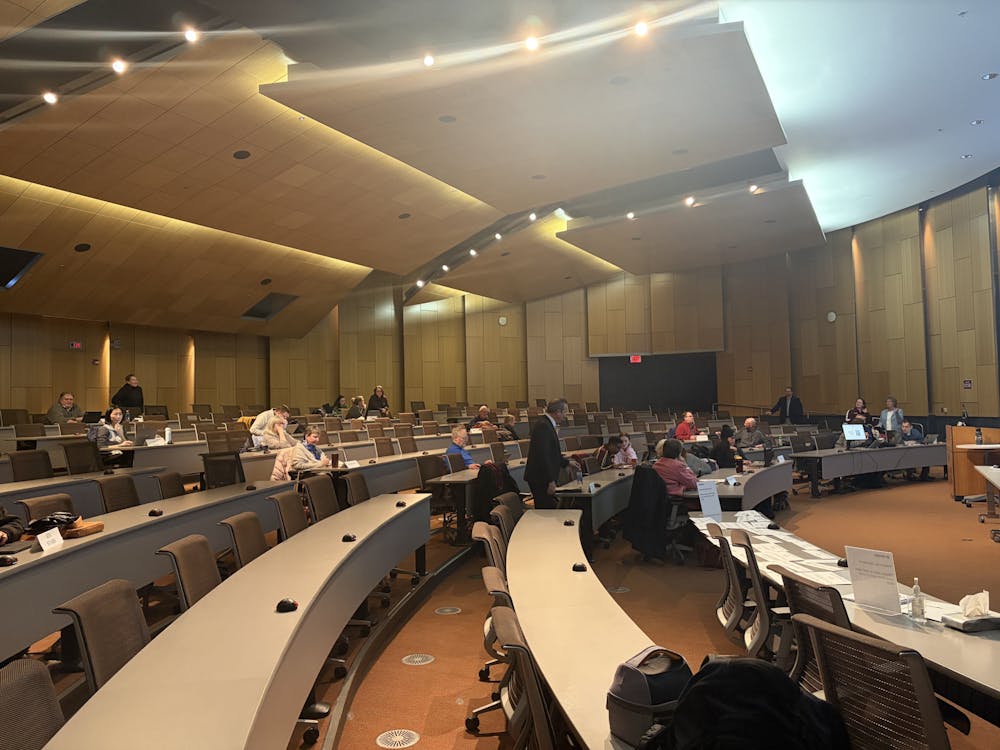
Central Michigan University's Academic Senate meets on Jan. 20 in the French Auditorium.
The new Central Career Guarantee program promises Central Michigan University students $2,000 if they can't get a job within six months after graduation.
The program is one of the strategies to increase enrollment, said President Neil MacKinnon and Vice President of Student Recruitment and Retention Jennifer DeHaemers at the Academic Senate on Jan. 20.
"Almost every university talks about preparing students for careers and jobs, and that's true," MacKinnon said. "But to guarantee that you're actually going to get a job offer or (be) admitted to grad school, or we owe you, that makes us very distinct."
According to CMU's CCG website, undergraduate students who go through the program and complete specific career-readiness requirements are guaranteed a job offer or admission to graduate school. Otherwise, the university promises to provide additional support, such as $2,000 applied to student loans or a continued job search.
Students can apply for the Central Career Guarantee by opting in once they meet eligibility requirements, including being a domestic undergraduate student with at least 60 credit hours remaining. New students must opt in during their first semester, while current students with enough remaining credits will be able to opt in during the fall 2026 semester, with instructions provided by the Central Michigan University website.
The Central Career Guarantee officially launched on Jan. 15, and administrators said the initial response has been strong.
“Just our first day, we had 449 students hit the apply button on our website,” MacKinnon said.
He added that the launch generated widespread attention, with “150 media outlets across the nation” covering the program and an estimated “$6.7 million in media attention” on the first day alone.
MacKinnon said they plan to continue promoting the Central Career Guarantee through advertising campaigns, social media and regional marketing as part of CMU’s broader enrollment strategy.
General Education
The Academic Senate also approved an amendment to the proposed new General Education program on Tuesday that changes who may propose courses for the Oral Communication foundational skill. The oral communication competency is a requirement within CMU’s General Education program that focuses on helping students learn effective speaking and public presentation skills.
When introducing the amendment, Senator Paul Collins explained that it would change the responsibility for proposing Oral Communication courses from the Communications Program to the College of Arts and Media (CAM) Curriculum Committee, with approval remaining with the General Education Committee.
“The oral English competency has historically been interdisciplinary in nature, as the current courses in this category are offered through multiple programs within the College of Arts and Media,” Collins said. “It’s appropriate to acknowledge that the diverse skills taught in this area can be best achieved through the multi-program approach that has served CMU students for well more than two decades.”
Josh Smith, the university’s General Education coordinator, later clarified the intent of the amendment, noting that it concerns decision-making authority rather than open submissions.
He explained that under the new framework, “proposals are restricted to certain areas, this change would suggest that CAM would then be the body that proposes to the General Education Committee and courses for inclusion in oral communication.”
Some senators, like Kirsten Weber, opposed the amendment, arguing that foundational skills should remain housed within their respective disciplines.
“It makes more sense that if math oversees the math competency, English oversees the English competency, and communication oversees the oral English competency,” Weber said. “I would be opposed to changing that language, and I would want to keep it in communication.”
Supporters of the amendment pointed to the role of theater and dance in teaching Oral Communication courses.
“For a very long time, most of the classes to offer oral competency have been in my department, theater and dance," Senator Stanley Bowen said.
After the discussion, the Senate voted by secret ballot. The amendment passed with 26 votes in favor, 20 against and five abstentions. Due to the meeting reaching its time limit, the Senate postponed final consideration of the overall General Education proposal until its next meeting.


