Michigan transparency effort stalls in House
State leaders preach transparency while blocking the public’s right to know
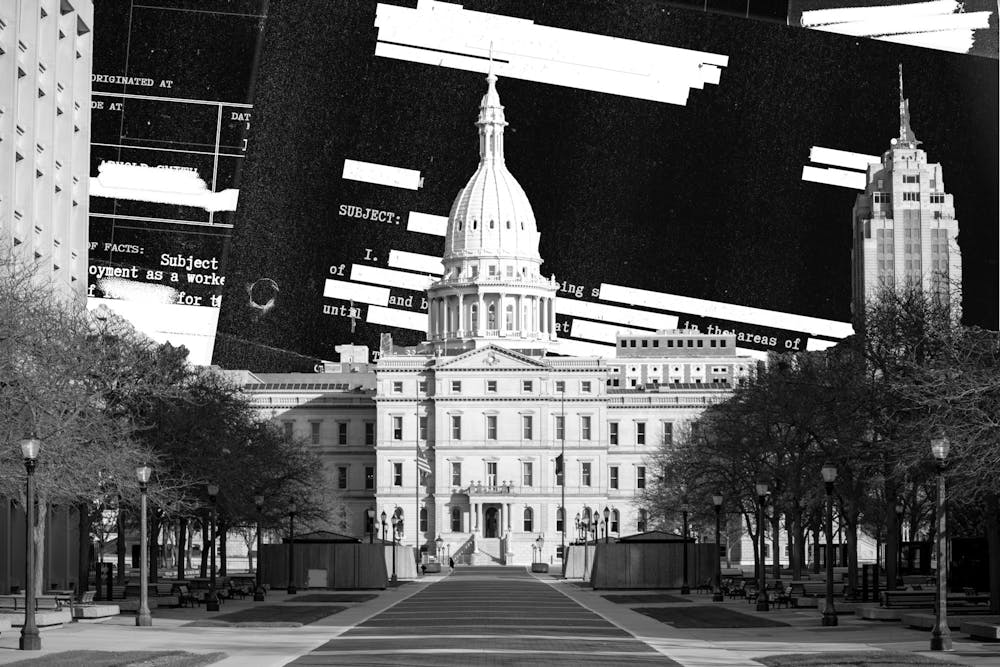
Michigan Speaker of the House Matt Hall kills FOIA expansion, keeping governor and lawmakers shielded from transparency and accountability (Blace Carpenter | CM Life)
This story was produced by the Michigan Press Association. Blace Carpenter, Central Michigan Life's managing editor, was the MPA's Fellow in 2025.
Michigan and Massachusetts are the only states where citizens cannot submit a Freedom of Information Act request to collect records from their executive and legislative branches.
For years, both Democrats and Republicans in Michigan have advocated expanding FOIA to include the two branches of government, but no deal has been reached.


Currently, two bills aiming to expand Michigan’s FOIA laws (Senate Bills 1 and 2) are sitting in the House’s Governmental Operations Committee awaiting discussion. However, Michigan Speaker of the House Matt Hall stated that he wasn’t interested in putting the bills on the agenda.
“We’re just not going to do FOIA,” Hall told reporters during a Nov. 6 press conference.
Michigan’s Democratic-led Senate started 2025 by quickly introducing and passing the bills, with 33 yeas and two nays. After moving off the Senate floor, SB 1 and 2 were read by the House and have remained in committee since January.
“If this were put up for a vote in the house, it would pass,” said Sen. Jeremy Moss (D-Bloomfield Township), co-author of the bills. “There’s no doubt. It has the votes.
“The question is, why won’t the speaker put it up for a vote?”
Hall recently celebrated the passing of two earmark reform bills (Public Acts 32 and 33 of 2025), which require legislators to disclose spending on individual projects before a final budget is put up for a vote. The passing of these bills completes part of Hall's Ethics, Accountability and Transparency (HEAT) plan, which he believes will be more beneficial to the public than expanding FOIA.
“We ask people all the time, they know HEAT will have a much better benefit than FOIA,” Hall said during the conference.
Michigan Press Association Public Policy Manager Lisa McGraw said that the reform bill is a step in the right direction, but that the state government could, and should, do more.
“I think until the governor and the legislature in the state are subject to FOIA, we really have no transparency at the state level,” said McGraw, who has been working to expand FOIA since 2015.
Hall did not provide a comment for this story.
Senators Moss and McBroom’s mission for FOIA
SB 1 and 2 are in the same position as other FOIA expansion bills that have been introduced in recent years.
Since joining the State Senate in 2019, Moss and Sen. Ed McBroom (R-Vulcan) have co-authored four bills in an attempt to expand FOIA:
- Senate Bill 1 of 2025
- Senate Bill 2 of 2025
- Senate Bill 669 of 2023
- Senate Bill 670 of 2023
While serving as the state representative for Michigan’s 35th District, Moss introduced House Bill 4149 of 2017, which would have made the legislature and the governor subject to FOIA. Just like his and McBroom’s Senate bills, the House bill was referred to committee and wasn’t put on the agenda for a vote.
“It was the first bipartisan package that got out of the House that term, and the Senate Leader (Arlan Meekhof) said, ‘I’m not taking this up,’” Moss said.
According to a 2017 story by the Detroit Free Press, Meekhof told journalists, “You guys are the only people who care about this,” referencing Moss and McBroom’s bill.
Both senators will be term-limited at the end of 2026. Both stated they will continue to push for expanding the public’s right to know.
“We would really like to see this project through,” Moss said. “It's not fun to work on something for 10 years, and make progress on it, and not get past the finish line. But we're working really, really hard to achieve this.”
The campaign on FOIA expansion
In 2018, Gov. Gretchen Whitmer stated that she would work to expand FOIA laws to include the governor's office and legislature.
“I mean, unilaterally we could open up the executive branch to FOIA and ensure that there is real notice and real searchable capabilities online,” Whitmer said in an interview on PBS Detroit in July of 2018. “The public and the press need tools so they can get information.”
Whitmer signed Public Acts 32 and 33 of 2025 into law and praised the bills.
“Since I took office, I’ve been committed to increasing transparency in our government, so Michiganders know exactly where their hard-earned dollars are going,” Whitmer stated in a press release. “I made a promise to increase transparency on legislative earmarks in my most recent State of the State. Less than a year later, I’m proud to sign these two bills that require lawmakers to put their names on any projects they propose.
“I’ll keep working with anyone to serve Michiganders and increase transparency in our government."
Whitmer made the calendars for her office and the office of Lt. Governor Garlin Gilchrist open to the public, as well as her federal income tax returns and personal financial information.
However, her promise to extend FOIA to her office has not yet been met.
Whitmer did not provide a comment for this story.
“Since the (Whitmer) administration started, we have not gone anywhere despite an entire campaign called the Sunshine Report, when she was running the first time,” said McGraw.
In 2018, Whitmer released an eight-page document titled “Get it Done: Michigan Sunshine Plan,” highlighting issues with Michigan’s transparency and ethics laws and what she wanted to change if elected governor.
“If the legislature won’t act, I will use the governor’s authority under the Michigan State Constitution to extend FOIA to the Lieutenant Governor and Governor’s Offices,” Whitmer stated in the report. “Michiganders should know when and what their governor is working on.”
While discussing the history of politicians advocating for expanding FOIA, Attorney General Dana Nessel told CM Life that false promises are often made during campaigns.
“No one runs for governor being like, ‘absolutely not, I don't agree with that,” Nessel said. “Everyone says what they think everyone wants to hear, and maybe they really think that, until they get (into office).’’
As Whitmer’s term comes to an end in 2026, candidates in the gubernatorial race have started to make promises on expanding FOIA.
“On day one, I will voluntarily comply with FOIA,” said Democratic candidate Jocelyn Benson, who has served as Secretary of State since 2019. “Every job I've had, whether it's been running a law school or running the Department of State, I've complied with FOIA proudly.”
Republican candidate and Former House Speaker Tom Leonard shared a similar commitment during an interview with CM Life in October.
“Michigan is only one of two states in the entire country whose executive branch and legislature is not subject to open records and FOIA. That needs to change,” Leonard said. “People of this state deserve to know what's going on in their executive branch and legislature.”


