Academic Senate approves AI language change in general education
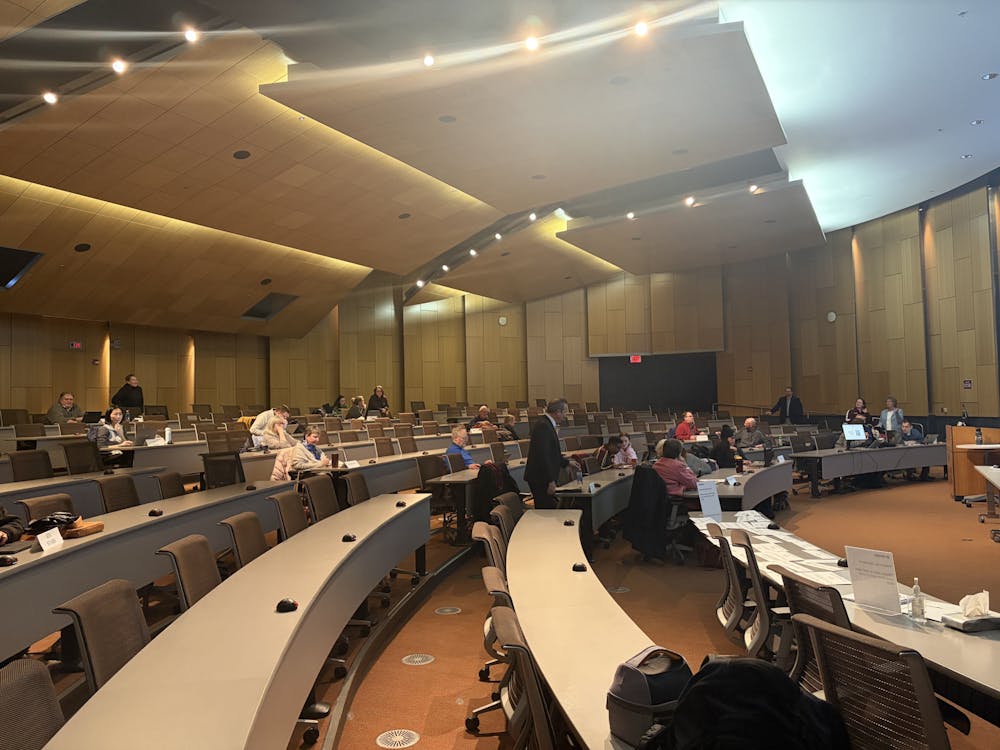
Central Michigan University's Academic Senate meets on Jan. 20 in the French Auditorium.
After debate over artificial intelligence, academic freedom and student costs, the Central Michigan University Academic Senate voted to revise AI language within the Central Education General Education program and eliminate the proposed Central Experience course.
Senator Heather Kendrick, faculty in the Department of Philosophy, Anthropology and Religion, proposed an amendment to revise the language in the information and digital literacy learning outcome. This gives faculty more discretion in how artificial intelligence is used in the classroom.
In a 48-3 vote, Kendrick’s proposal to clarify the wording of the university’s policy on AI use in the classroom was adopted.
The new statement is, “students will identify, evaluate, and use information and digital tools such as artificial intelligence ethically and effectively.”
The revision shifts artificial intelligence from being listed alongside digital tools as a separate component to being presented as one example within the broader category of digital tools. It also removes the phrase referencing support for “critical inquiry, creativity, and lifelong learning” and adds the word “effectively.”
“I am of the belief that so-called generative AI, which I assume is being implied here, is ethically problematic, and that the current attempts by those to hope to profit from it, to encourage dependence on it, should be resisted," Kendrick said.
Senator Cole Bartels, faculty in the School of Music, emphasizes the effects of reliance on AI tools.
“It becomes very difficult to write basic things when relying upon generative AI tools, even just a few times," he said. "If we want to be good stewards of academic success, we want to be careful about having this language written in that requires the use of AI in some capacity.”
At one point, Senator Joellen DeLucia, professor in the Department of English Language and Literature, proposed taking the word “ethically” out of the revised outcome entirely, arguing that many faculty members are uncomfortable suggesting AI has an ethical use. That amendment did not advance after discussion.
Kendrick ultimately declined to support removing “ethically,” noting that faculty who choose to teach AI should engage students in ethical analysis of it.
Removal of the proposed Central Experience course
The Academic Senate also discussed and ultimately voted to remove the proposed Central Experience course from the Central Education General Education program.
Central Experience is a proposed three-credit foundational course within the new general education framework at CMU designed to support first-year students in their transition to college-level learning.
Senator Lawrence Lemke, a professor in the Department of Earth and Atmospheric Sciences, argued that while the course could help students develop essential learning skills, similar programs already exist that target students' needs without adding credit hours.
“Both the Go Grant How to College seminars and the Strategic Enrollment Management Success workshops have learning outcomes that mirror those of central experience," he said. "But in contrast to central experience, they're targeting students who need this type of experience the most, and they're designing them to be delivered for zero credits."
He also raised financial concerns, noting that requiring all students to take the course could be costly.
“Do we really need to require every freshman to pay $1,500 in tuition, or devote $1,500 of their financial aid resources to a three-credit course like this?” Senator Lemke said.
Bartels raised questions about staffing and workload.
“If staff are going to teach this, I hope CMU is prepared to adjust their workload accordingly, or pay overload, or hire more staff," he said. "We all know how much work goes into teaching a single three-credit course."
Senator Joshua Smith, faculty in the Department of Philosophy, Anthropology and Religion explained that the learning outcomes were designed to be intentionally broad, giving instructors flexibility to adapt them to different courses.
“The learning outcomes are the bare minimum of what must happen in these courses," he said. "So much more needs to happen to fill this out in order to make clear exactly what it has to be."
The motion passed with 29 in favor, 23 opposed and three abstentions, officially removing the Central Experience language from the Central Education framework.


