Board of Trustees addresses proposed changes to Student Conduct, retention rate increase
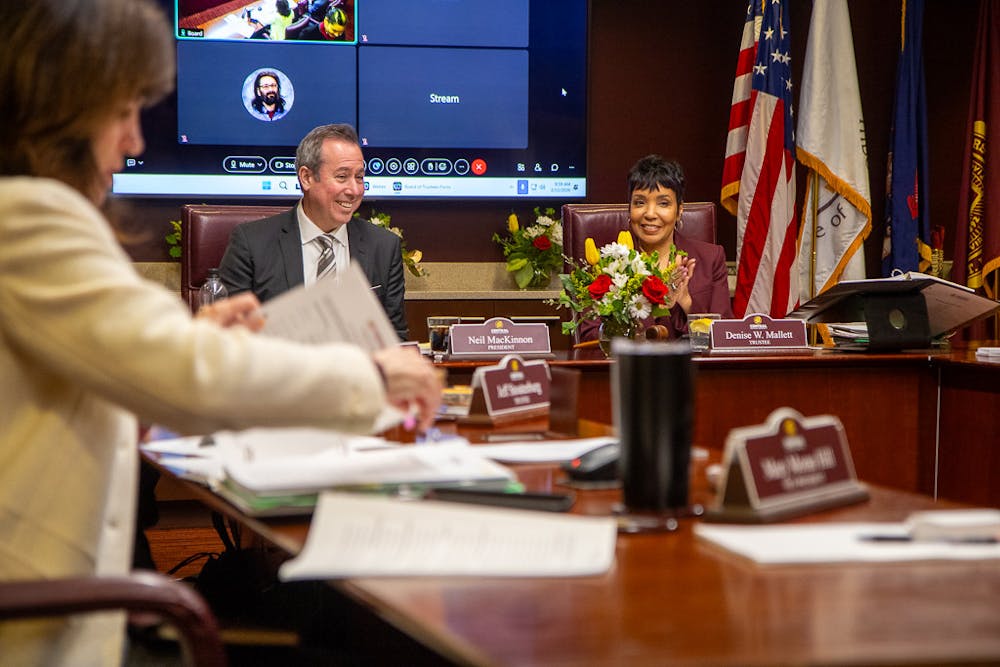
Central Michigan University President Neil MacKinnon sits beside Dr. Denise Williams Mallett, chair of the Board of Trustees before the first Board meeting of the year begins in Bovee University Center, on Thursday, Feb. 12, 2026. This was Chair Mallett's first meeting in her new role. (CM-Life | Cristin Coppess)
The Office of Student Conduct is proposing to change its procedures to reflect current societal concerns and the way students currently behave, Trustee Sharon Heath said at the Board of Trustees meeting on April 22. The current procedure, Heath said, does not consider “threats of mass violence," and will address new ways students behave.
"Unfortunately, updating the code will allow more context-sensitive responses and better address disruptive behaviors," Heath said. "The updated code will be presented for board review, and is expected to provide new options for holding students accountable and addressing disruptive behavior in classroom and living environments."
Also at the Academic and Student Affairs Committee, Heath said the committee is looking to build its partnerships with community colleges and charter schools.
The committee will be doing this through transfer agreements with schools, expanding the Central Bound Program to community colleges and deepening its relationship with charter schools authorized by Central Michigan University, she said. The university is also aiming to work with the main campus and online programs on ways to better serve charter schools.
“The aim is to better support, transfer, host traditional and charter school students as educators,” she said.
Additionally, Heath said the university's Counseling Center is hoping the Community Outreach Mental Health Persistence and Student Success (COMPASS) program will help with mental health challenges on campus.
She said 943 students have had 3,441 counseling sessions this year due to mental health issues. Some of the top three issues students seek the Counseling Center services for include stress, anxiety and depression.
“The care team is finding more students are entering college with substantial histories of mental health treatment, increasing the demand for coordinated support across campus and external resources,” she said.
Enrollment, Retention and Student Success
Trustee Regine Beauboeuf said the student retention rate has increased since last year, despite the decrease in international student enrollment. The one-year retention rate between this year and last year was 78%, according to the Academic Planning Analysis. The retention rate between 2023 and 2024 was 74.7%.
This information is from a newly established dashboard created by the Student Enrollment, Retention and Success Committee that looks at enrollment numbers, the success of students and more, Beauboeuf said.
“Enrollment is our number one priority for us, the campus, the university, the president and the board, and so there is a great emphasis on that,” Beauboeuf said.
The university will now be looking at retention within the Strategic Enrollment Management Plan, Vice President of Student Recruitment and Retention Jennifer DeHaemers said.
DeHaemers also said the university is currently working with charter schools to recruit students, have high school students visit campus and increase scholarships available to charter school students.
“When we looked at all of the charter school students that we had admitted last year to the university, we were…the number one choice compared to other universities,” DeHaemers said.
Finance and Facilities
Trustee Edward Plawecki discussed CMU's budget and construction plans during the Finance and Facilities committee.
“This year, the budget will also be challenged; however, steps are being taken by the president, administration and board ... to not only keep CMU fiscally sound but to increase domestic enrollment was (a) strategic enrollment plan for (the) fiscal year 2026-2027," he said.
Plawecki said the committee believe the school’s programs, goals and athletic programs will remain exceptionally strong.
“We are on very strong footing, no matter what you read, no matter what you hear,” he said. “We’re going on for the next five years.”
Andy Reihl, director of university engineering and planning, discussed the upcoming projects on Central Michigan University's calendar, noting that there are currently 61 active projects for 2026.
For all the new projects, the total bill comes to $100 million, with projects like Ronan Hall, Merrill Hall and the new women's and men's golf facility.
“This one (was) further refined during our 2024 campus programming effort to provide a major student services hub for our students,” Reihl said about the Ronan Hall renovation. “Also, reducing the space with full utilization of the garden level.”
Construction for Ronan is currently set to commence this summer, with a final projection expected by January 2027. The hall will continue to house the student food pantry.
Central Michigan Life previously reported that the golf building and Merrill Hall renovations have been on the radar recently.
The Merrill renovations in total cost $10 million and are expected to be finished by Summer 2027.
The key donor for the golf building offered an additional $1.5 million gift because the total costs increased for the building.
“Vice President (Mary) Hill will be presenting (a) proposal resolution related to this additional generous gift of $1.5 million for an overall project budget at $10.4,” Reihl said in his presentation.
Access, Belonging and Community Impact
Trustee David McGhee discussed what the Access, Belonging and Community Impact Committee is designed to focus on and the metrics.
"Educational access, along with campus climate, employee well-being, student belonging, community partnerships, as well as culturally responsive leadership," he said.
The committee will serve as facility blocks for the work that takes place, McGhee said.
Athletic Affairs Committee
Todd Regis, Board of Trustees member, announced that an athletic affairs committee has officially been formed with the stated goals of monitoring student-athletes success and keeping track of the financial stability of the athletics department.
"We are going to be looking at our budget with other MAC (Mid-American Conference) universities, NIL money spent at CMU versus other MAC schools and we are going to look at how various revenue reports show the financial stability of our programs," Regis said.
The committee will also be in charge of monitoring and assessing Central Michigan as an athletic program as it pertains to brand value and NIL in the constantly changing landscape of college sports.
"Just today we have seen via email and text messages, three different things that have come out involving NCAA athletics changes," Regis said. "There are alleged millionaires at some schools that are student-athletes and all sorts of reporting trying to sort through what is fact and what is fiction is important. We are going to look at all of that."
Trustees-Student Liaison Committee
Four CMU student led organizations spoke about their highlights from the year.
Kendall Fowler, President of the Program Board, talked about the team’s achievements and how they have been expanding engagement.
“We have found a lot more success with that this year,” Fowler said.
He said the board saw that students don’t want to stay at events for a long time. This year, they hosted more low-commitment and high-engagement events, such as arts and crafts events.
Fowler said the board wants to bring more events to students, such as to the dorms, so they can know what events are going on.
Max Fursaro, president of the Residence Housing Association (RHA), went to the Great Lakes Affiliate of College and University Residence Halls (GLACURH). Through conferences, GLACURH connects residence hall leaders for leadership development recognition.
CMU will also host next year’s event from March 12 to 14, which is the first time for the region since 2006 and the first regional business conference since 1991.
The RHA spent $17,941.45 on programs, $8,918.68 were allocated to registered student organization events and $9,022.77 were allocated to Residence Life programs.
The Student Government Association (SGA) went over what it promised for the year, such as increasing student engagement, supporting RSOs and leaving an impact.
Kathryn House, Vice President, emphasized their focus on increasing student engagement and accessibility. For example, SGA members visited classrooms and student events. They also hosted inclusive events such as a Lunar New Year celebration and expanded student representation on university committees.
The Student Sustainability Committee went over the legislation that was passed and the allocations last year:
Spring 2025
- $45,000 for the feminine hygiene products initiative to provide menstrual products for students
- $30,000 for installing water bottle fillers around campus
- $25,000 central sustainability retroactive base funding
- $6,600 for Leadership & Sustainability Alternative Break (Volunteer Center)
- $4,800 for campus garden improvements
- $2,250 for sustainability forum memberships (research, etc.)
- $150 for the campus pride index
Fall 2025 Allocations
- $26,000 for Central Sustainability
- $13,000 for a bike share pilot program so students can rent bikes
- $12,000 for the feminine hygiene products Initiative (additional supplies)
- $5,800 for a potential orchard on campus
Regis said that the Student Food Pantry received a $99,982 grant through the Michigan Lifelong Education Advancement and Potential Committee.
Trustees-Faculty Liaison Committee
Professor Kevin Pangle, director of the CMU Biological Station, spoke to the board about the Beaver Island Biological Station and what it provides for students.
The station is an immersive academic and research facility, Pangle said. It spans 130 acres for student housing, learning and more.
Pangle said the courses at the station aren’t just for biology majors. He said there are a variety of courses, such as biology, art, sociology and more that are immersive and involve outdoor activities.
The station provides hands-on research in environmental science, wildlife and community-based projects.
Odil Dilmurodov, CMU undergraduate, said that he was part of a research team to study the trails on the island and how they affected the wildlife. He said it was very community-driven and gave him the opportunity to work with people already in ecology.
“It's my favorite part of CMU,” Mallory Morrison, CMU undergraduate, said. “It is so hard to get stressed up there because you wake up in the morning and you can see the sunrise.”
Students get to move outside of a traditional classroom and work with real environmental problems, Pangle said.


