Heating tunnels underneath campus never intended for student use, officials say
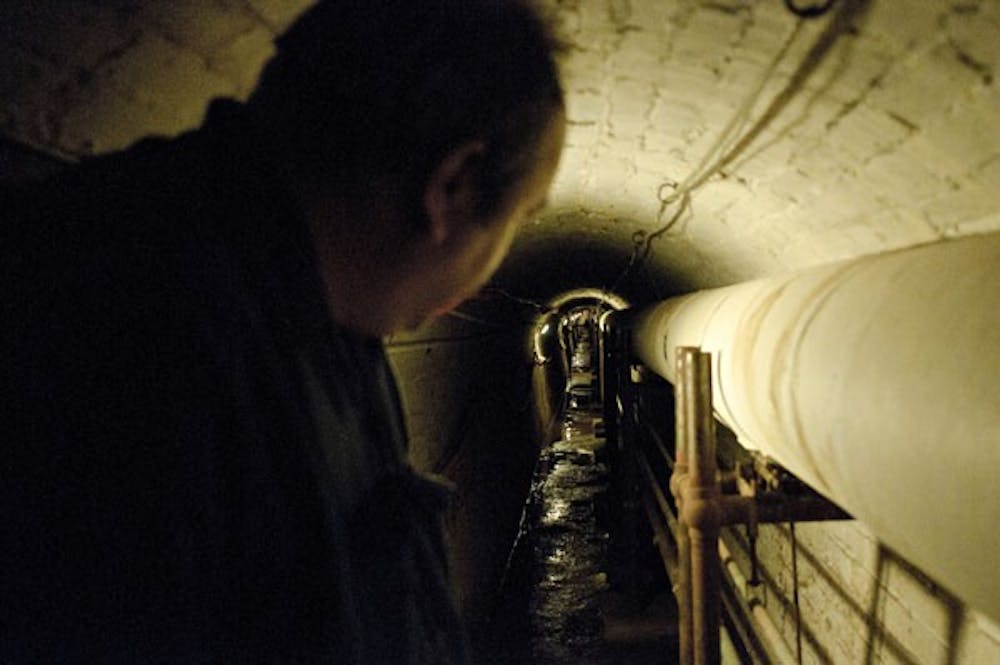
Central Michigan University has its own Chamber of Secrets — a network of underground tunnels.
The popular myth is they were built for students to use during winter when snowfall was too heavy to move above ground and, over the years, crimes and other dangers led to their closure.
But Mark Blanzy, supervisor of utility operations, said the myth is patently false.
“It’s hot, wet, dangerous, there’s stuff to knock your head on, there’s stuff to trip over and there’s hot pipes exposed everywhere,” Blanzy said while down in the tunnels earlier this week, “so the main thing is just stay out of them.”
Some spaces are so narrow, maintenance mechanics must use a car creeper to pull themselves down the tunnel.
The tunnels were built during the same time the university buildings were. They span around 2.7 miles across the university, Blanzy said, costing nearly $2,700 per foot.
LeRoy Barnes, director of plant energy and utilities, said the tunnels were always intended only for utilities.
“The purpose of the tunnels is to carry and house the piping that takes our heat or steam to different buildings on the campus,” Barnes said. “They preserve and protect the piping that meets the thermal requirements of the campus.”
Most major university campuses have similar heating tunnels. Barnes believes the rumors of student uses may have started from other such colleges.
“I know that there are other campuses where they have made large tunnels between buildings that carry steam lines and are also for humans to go from one building to another,” Barnes said. “So maybe people that came to the campus thought that ours were similar to that.”
Blanzy’s job is to ensure the steam leaves the CMU Powerhouse through the pipes. This keeps temperatures in the underground around 90 degrees with 100 percent humidity.
Snakes in a tunnel?
Blanzy said the warmth has led to rumors of Brooks Hall losing snakes there.
“There are horror stories of them finding snake skins shed down here, but you don’t know,” he said. “I haven’t seen it, but I think it’s possible.”
Many students are unaware of the tunnels. Even Big Rapids sophomore Stephanie Borstler, an assistant in Facilities Management, had never seen them.
“I never even knew they existed and I’ve worked here for over a year,” Borstler said. “I wouldn’t come down here. It’s creepy.”
The entrances to the tunnels are kept locked. Alarm points sound if any unauthorized door is opened. Students may face punishment up to expulsion if they are caught sneaking in, Blanzy said.
“For safety, any door you come to in the tunnel system you can get out of,” he said, “but they’re locked on the outside so you can’t get in.”
Even with the security system, some still manage to sneak a peak. Blanzy said there was a break in on the last day of school in May.
“At 2:00 in the morning my alarm goes off — somebody had tried to come in,” he said. “I called the police and told them somebody was in the tunnels. We caught the kids, basically lost.”
During the Halloween season, the urban myths of the tunnels come back to life, sparking people’s interest once again.
Blanzy said there’s a hype about the tunnels this time of year.
“That’s why it’s on everybody’s senior bucket list is because they hear the rumors,” he said. “There’s nothing exciting down there as you can see, it’s just a tunnel.”


