Graduate apartments earn high marks for energy efficiency
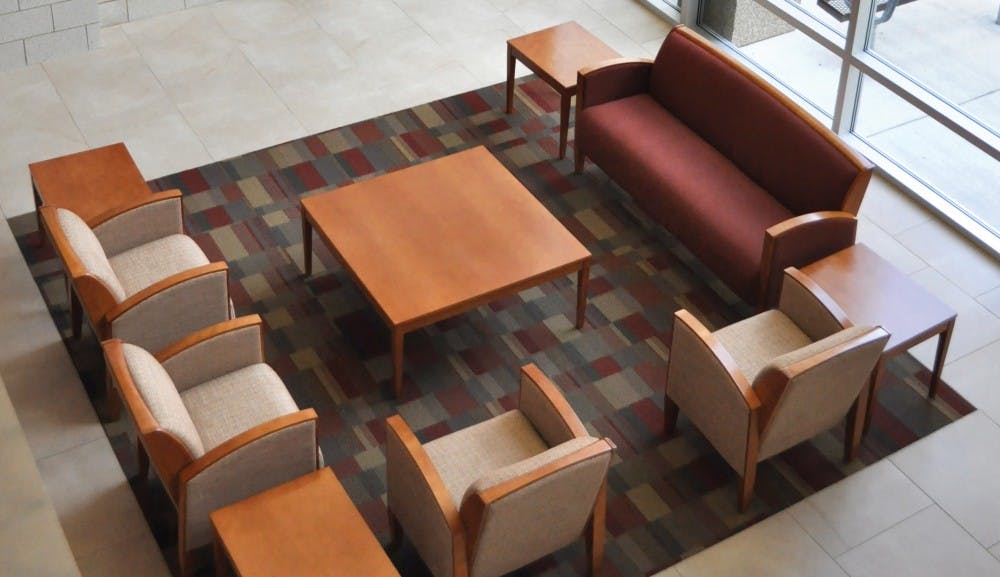
Central Michigan University's newest buildings have been recognized for being some of the most environmentally friendly in the region.
The new graduate student apartments, which opened this year on north campus, became the first multi-family building in the Midwest to receive a platinum designator for Leadership in Energy and Environmental Design certification.
LEED certification, offered by the U.S. Green Building Council, is a program that provides third-party verification for environmentally friendly buildings. To qualify, certain prerequisites must be met to achieve varying levels of certification.
Even prior to earning the highest rating possible, achieving LEED certification for the buildings were a goal from the start, according to Linda Slater, director of Plant Engineering and Planning.
“During the design phase of the project, the CMU team worked with the architect using the LEED for homes checklist and established a goal of platinum certification for this project,” she said.
According to Slater, the requirements for certification fall under a set of categories including innovation and design process, location and linkages, sustainable sites, water efficiency, energy and atmosphere, materials and resources, indoor environmental quality, awareness and education.
Steve Lawrence, CMU's vice president for Facilities Management, said the LEED checklist is considered before every new project begins construction on campus.
“We go through the checklist, which has a lot of categories and figure out which ones we can do,” Lawrence said. “This helps guide us in design.”
For each requirement met, a certain amount of points are awarded. In order to achieve platinum certification, 80 points are required.
The graduate housing project scored above the platinum requirement, with a total of 82.5 points.
According to Slater, some of the ways the project was able to earn points included installing high-efficiency water fixtures to reduce indoor water use, recycling to minimize construction waste and by reducing the energy required for these buildings by 36 percent.
Lawrence said there are not many additional costs to achieving platinum certification.
“There can be some extra costs, but generally, these costs are fairly low,” Lawrence said. “We feel in the long run it’s worth following LEED guidelines. If you can design a building that uses less energy, that’s a good thing.”
Gold, silver and standard certification are also available with point requirements of 60, 50 and 40 respectively.
Slater said by continuing to follow these guidelines, the university will save money and trouble in the future.
“Making smart choices during the design and construction process can positively impact both the quality of the building for the tenants and the long-term costs of operation,” she said.


