Navigating the field
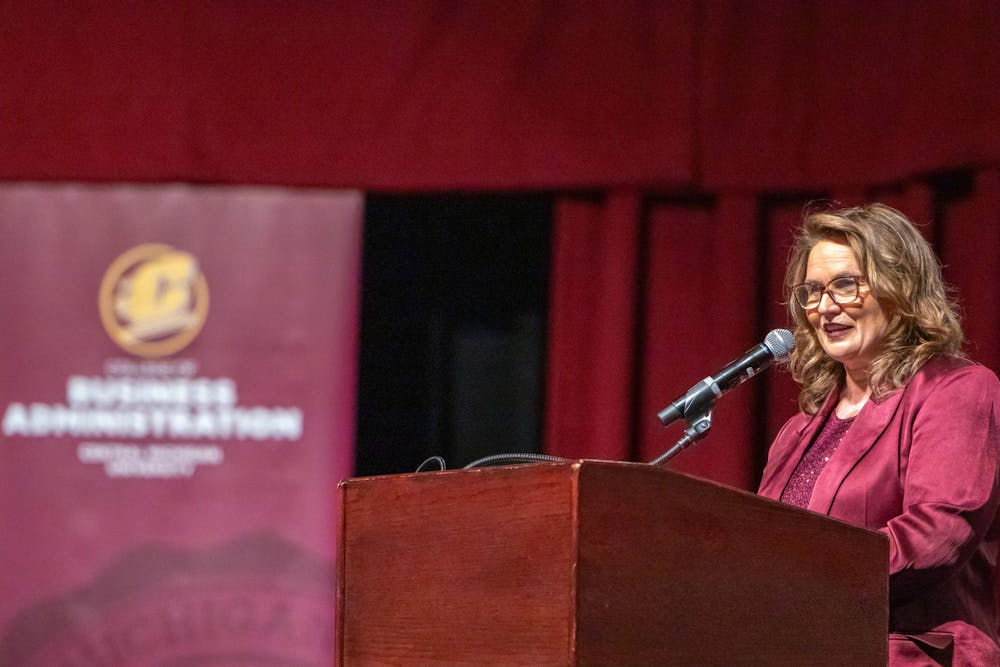
Central Michigan Athletic Director Amy Folan gives a speech during the award ceremony at the Maroon and Gold Gala, at McGuirk Arena, Monday, April 28, 2025. (CM-Life | Mark Hoover)
Of the five Division I competitors in Michigan, Central Michigan spends the least money on athletics and stands as one of two schools in the state, along with Eastern Michigan, that have not won a national title in the last 25 years.
However, the landscape 25 years ago is far different from the outlook now. In this new era, name, image and likeness has taken center stage in athletics. Since its introduction, Central Michigan has taken new approaches and strategies to market the university and its people.
However, the degree of marketing is determined by the resources available. Fortunately for the athletics program, the capital is higher than ever, according to the CMU athletic director Amy Folan.


She wrote in a statement that CMU has raised the most money in its athletic department’s history. In addition, the department has hit all-time highs in revenue, while spending is relatively in line with the Mid-American Conference.
“CMU Athletics functions as a $45 million advertising and branding vehicle for Central Michigan University,” Folan wrote. “Every game broadcast, every ESPN appearance, every logo on a national stage is exposure that no traditional marketing brand could replicate.”
Overall, Folan said that CMU athletics is “in a strong position.” She cited the fact that the football team was one of five MAC teams to make a bowl game. The women’s basketball team was a No. 4 seed in the conference tournament, and the gymnastics team has won three of the last four conference championships.
However, the landscape is only continuing to shift in college sports with the complex additions of NIL deals and the transfer portal. Central Michigan must learn to adapt, and Folan has readied to face these challenges.
“This is not a moment to rest,” Folan wrote. “The financial demands of programs like ours are growing, even though we remain committed to operating responsibly.”
As a result, the athletics department has begun to work closely with the CMU Board of Trustees to tackle the new realities in college sports.
On April 22, the Board of Trustees announced the creation of an athletic affairs committee to better assess CMU’s financial standing in the NCAA and monitor the changing landscape of college sports.
“We are going to be looking at our budget with other MAC universities, NIL money spent at CMU versus other MAC schools and we are going to look at how various revenue reports show the financial stability of our programs,” board of trustees member Todd Regis said at the board of trustees meeting.
Folan is also establishing a Task Force on StudentAthlete Benefits, focused on bringing Central Michigan leaders and alumni together to approach the changing landscape of sports.
“This group is asking hard questions about sustainability, competitiveness and what it means to support student-athletes in an era that looks nothing like the one that came before,” Folan wrote. “Their work will help shape how CMU positions itself — not just to survive this moment, but to lead through it.”
Approaching NIL
It’s no secret that Central Michigan, along with its MAC peers, faces a significant disadvantage in terms of financial support for its student-athletes.
“We are losing talented student-athletes to institutions who can simply pay more,” Folan wrote. “That is the reality, and I’m not going to pretend otherwise.”
According to the Knight-Newhouse College Athletics Database, the MAC budgeted nearly $103 million for student-athlete aid. By comparison, Power Four conferences significantly eclipsed these totals, including the Big Ten spending just over $257 million in scholarships alone.
The difference is clear.
“How do we compete? First, by being honest about what we are and what we are not,” Folan wrote. “We are not going to outbid Power Four schools. We are not going to pretend the financial playing field is level, because it is not.”
With such a vast financial disparity across the various levels of the NCAA, Folan instead seeks to construct rosters through developing relationships and building character.
This tactic may be appealing in practice, yet a significant roadblock stands in the way of longterm roster development. With the rise of the transfer portal, students-athletes now frequently find themselves in the revolving door of roster construction.
The challenge of the transfer portal
The contrast is obvious between the Power Four and the mid-majors, and the transfer portal has proven to be a double-edged sword when it comes to leveling the playing field that NIL creates.
“Roster decisions that once unfolded over months now happen in hours,” Folan wrote. “A student-athlete can enter the portal in the morning and have offers by afternoon. The volatility is real, the financial competition is real, and the gap between what the wealthiest programs can offer and what a MAC institution can offer has never been more visible.
“But here is the other side of this story, and it matters: the transfer portal has opened doors for us, too. Studentathletes who entered larger programs and found themselves buried on a depth chart, overlooked in a massive athletic department, or disconnected from their institution are finding their way to places like CMU. And when they get here, they find something the rankings and revenue numbers do not capture.”
The athletic department has been transparent about the fact that it will be difficult to compete with Power Four opponents in recruiting, but acknowledging what CMU can and can’t offer is part of the battle.
“We are not going to win every recruiting battle in this environment. But we have the right people asking the right questions, the institutional leadership engaged at the highest levels, and a foundation that has never wavered,” Folan wrote.
How does CMU stack up in the MAC?
To stay relevant in the landscape of the NCAA, Central Michigan must first strive for success at the conference level.
In the MAC, CMU’s budget is on par with its peer institutions. Currently, it ranks seventh among the 13 total conference members, and Folan is encouraged by the overall production of the athletics department.
“We are doing more with less, and we’re doing it well,” Folan wrote. “We want CMU Athletics to be the standard other MAC programs measure themselves against — not just in wins, but in how we operate, how we serve our student-athletes, and how we represent this university and this community.”
Despite sitting in the middle of the conference in terms of financial support, Folan said she believes that the atmosphere of the university and the passion of its supporters are among the main draws to attract and retain student-athletes.
Behind the scenes of this style of recruitment, the Task Force on Student Athlete Benefits is fighting to create an athletics system that works for CMU’s current model in this new era of college sports.
Their purpose is to challenge and shape the athletics department’s financial roadmap while upholding the university’s integrity and core values.
“We have also made real investments in our ability to move quickly in this environment,” Folan wrote. “More staff resources dedicated to portal monitoring, faster decision-making cycles within our coaching staffs, and financial planning flexible enough to account for roster movement we cannot always predict.”
She said she aims to uphold the resources and opportunities CMU’s programs do offer, while remaining prepared for the event of sudden roster changes that can send shockwaves throughout an entire team.
This isn’t just an issue for Central Michigan, however. Other MAC programs have struggled to retain talent during the early NIL era, with the conference ranking last in the Football Bowl Subdivision (FBS) with a 41.1% returning production rate ahead of the 2025 season.
As CMU looks to stay relevant in a landscape where the odds are stacked against it, it raises the question of whether the athletics department has brighter prospects in a different conference.
The future of CMU athletics
Because of the movement in the MAC, the question of conference realignment is a palpable issue for CMU.
“Those factors (level, geography and values) do not change because the national conversation gets loud. And make no mistake — conference realignment is loud right now. But it is not new,” she said.
“Right now, what is in the best interest of CMU is competing at the highest level in the MAC, leading within our conference, and using that platform to position ourselves well on the national stage. That is exactly what we are doing.”
CMU’s athletic department is confident that it is prepared to face the challenges that await in the NIL era.


