Board of Trustees approves housing rates, discusses enrollment numbers
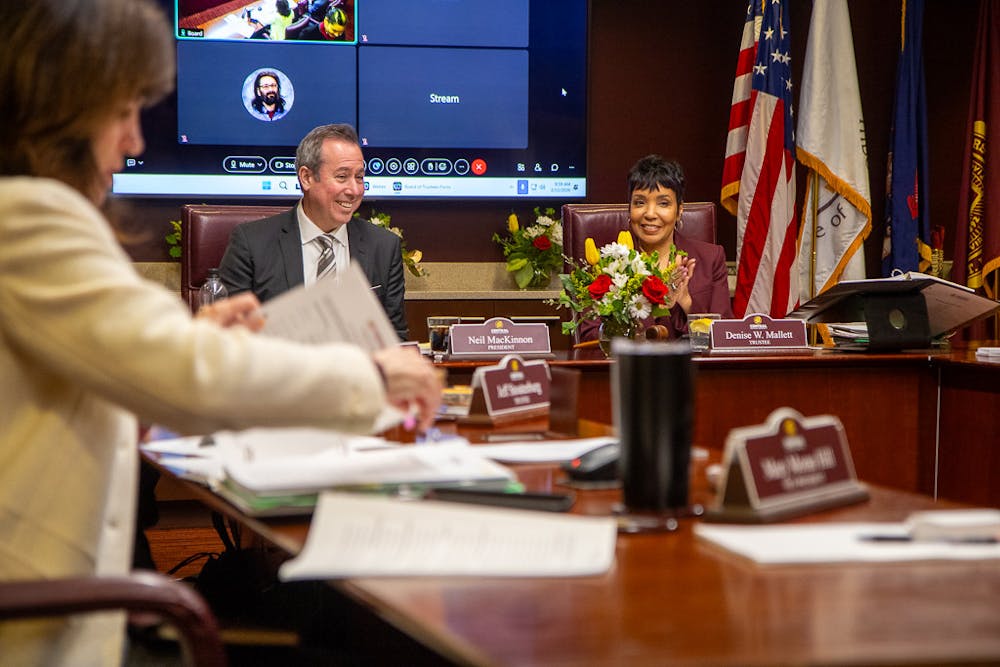
Central Michigan University President Neil MacKinnon sits beside Dr. Denise Williams Mallett, chair of the Board of Trustees before the first Board meeting of the year begins in Bovee University Center, on Thursday, Feb. 12, 2026. This was Chair Mallett's first meeting in her new role. (CM-Life | Cristin Coppess)
The Central Michigan University Board of Trustees opened the year with several unanimous votes to approve housing rate increases and facilities projects. They also discussedthe progression of CMU’s Strategic Enrollment and Management Plan in their meeting on Feb. 12.
The meeting also marked Dr. Denise Williams Mallett's debut as the Board’s chair. Mallett told Central Michigan Life that so far, it has been smooth sailing.
“The first month has been embraced by my board, the trust and commitment and support of the board, and them nominating me and voting me in unanimously to lead as chair,” Mallett said. “It's humbling, it's exciting.”
Finance and Facilities
The first was a vote to increase the cost of meal plans and certain housing for students in the 2026-27 school year. The new guidelines will also include another meal plan for upperclassmen living on campus.
Trustee Jeff Stoutenburg spoke on behalf of absent Vice Chair Ed Plawecki, offering several actions for the Board’s approval.
Standard housing options, such as South Community Residence Halls and some East Community Residence Halls, will retain their current price.
As previously reported by Central Michigan Life, the following residence halls will be impacted by a 4% cost increase:
- 2-person suits at Cobb, Troutman and Wheeler Residence Halls
- 2-person suits at Carey Residence Hall
- Campbell, Celani, Fabiano, Kesseler and Kulhavi Residence Halls
- Individual rooms in Cobb Residence Hall
“These recommendations are aligned with inflation trends and are offset by cost savings that are realized through the efforts to reduce food waste in the residence halls,” Stoutenburg said.
The Board also approved several facility updates around and outside of campus:
- Replacing audio-visual equipment needed for simulation centers for the College of Health Professions and College of Medicine, which will cost $1.6 million
- A new five-year lease in Troy, Michigan, that will serve as a space “used to support student recruitment, test proctoring, online enrollment, and advancement efforts.” The cost is capped at $1.25 million from the general operating budget
- Granted WCMU Public Media permission to purchase two radio towers in West Michigan
These projects follow numerous facilities projects approved by the Board in their November meeting.
In a post-meeting interview with CM Life, CMU President Neil MacKinnon said that officials have the difficult task of running a “mini-city” in terms of balancing needs for updates around campus.
He said officials consider a multitude of factors when choosing what projects to prioritize, including what students and faculty need, what potential students want to see and what money is available to spend.
“There's a lot going on in any university to balance all of that,” MacKinnon said. “What I'm grateful [for] is that I work with a board that understands we need to invest in the physical infrastructure. We can't spend all of our money in that, but there is a need to both take care of deferred maintenance and then also do renovations and some new projects as well.”
MacKinnon said the projects are also rooted in the university’s campus master plan. He elaborated on some future projects, saying that more renovations to the South Community quad will follow the recently announced renovations in Merrill Hall.
Enrollment numbers are not what officials had hoped for
In his opening report, MacKinnon addressed the most current enrollment data collected in the Jan. 22 student census. Domestic enrollment, he said, has increased by 100 students. Overall enrollment has once again decreased because of the drop in international students.
“Unfortunately, only a fraction of the 672 international students who deferred to the spring semester were able to get a visa to join us at CMU,” MacKinnon said. “While we are disappointed, we are not giving up.”
MacKinnon went on to give an update on progress made in CMU’s SEM Plan. Of the 33 different strategies that make up the plan, two major initiatives have already been rolled out: the Central Career Guarantee and the release of financial aid offers for recently accepted students earlier than most other higher-education institutions.
“It's a five-year plan, so we're not doing all 33 on day one,” MacKinnon said. “Our goal is to get around between 16 and 17,000. I feel we can accomplish the 17,000, but there are some factors out of our hands.”
He said officials have had to pivot a bit with the plan because the current national situation makes the university unable to rely on international enrollment to boost the numbers.
“We really can't count on international growth to get us to 16,000 to 17,000,” MacKinnon said. “It doesn't mean we're ignoring international students. But right now, more of our focus energy is on domestic students because we can get a little bit more control.”
Chair Williams Mallett has a 25-year career background in enrollment management. She said she holds a lot of confidence in the SEM plan to get the job done.
“The process that was done was thoughtful; it was inclusive,” she said. “Not only thoughtful and inclusive, but some of the outcomes and the tactics and strategies are innovative, new, something that I'm sure will be followed by someone else. The exciting thing is that we are taking a leap. We are investing in ourselves, investing in the institution and the students.”


