CMU sees increase in deposits after Central Career Guarantee launch
Board of Trustees holds committee meetings
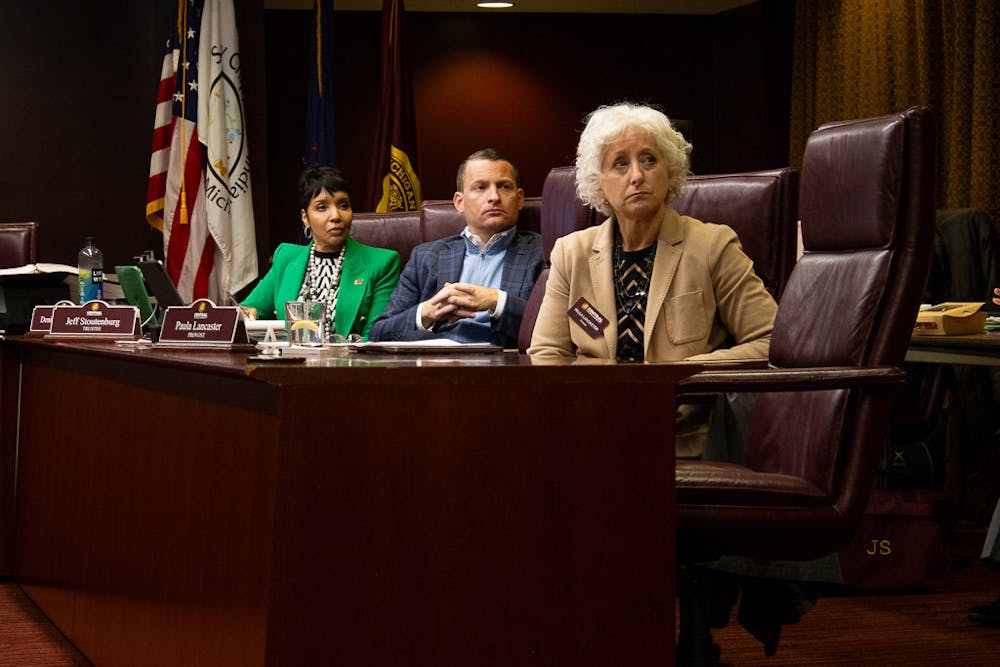
Central Michigan University Provost Paula Lancaster sits alongside Board of Trustees members Denise Williams Mallett and Jeff Stoutenburg during the opening public comments made at the meeting held in Bovee University Center, Mount Pleasant, Michigan, on Friday, November 21, 2024. Two student groups presented resolutions to the Board during the session. (CM-Life | Cristin Coppess)
Central Michigan University officials said they received positive feedback on the Central Career Guarantee.
This new initiative serves as a recruitment tool and generated an increase in commitment deposits, Jennifer DeHaemers, vice president of student recruitment and retention, told the Board of Trustees at the committee meeting on Feb. 11.
“What I'm hearing is that faculty and staff are really excited and feel like the university is making a bold step forward with this initiative,” she said. “We're also hearing from school counselors, parents and students that they're really excited about this opportunity, too."
The program promises $2,000 to eligible students if they don't get a job within six months after graduation, as Central Michigan Life previously reported.
“The number of deposits and the percentage of them have increased over (the) last year at this time by quite a bit," DeHaemers said. "We’re very excited about that. ... It’s showing early excitement from students and their interest in being a student at Central.”
Meanwhile, for the fall of 2026, international student enrollment is experiencing a negative impact, DeHaemers said.
“It is depressing our overall application and admission number for the university because that was such a large number of students,” she said.
DeHaemers said CMU is looking to offer online education for international students to stabilize enrollment.
In addition, she reported that the freshmen retention this spring semester is 91.5%, which is 0.8% down from last year. Some of those students had less than a 2.0 GPA. DeHaemers said CMU is offering student success seminars to improve study skills.
Finance and Facilities Committee
The Board of Trustees will be voting on Thursday to increase the cost of meal plans and housing next year. The plan also includes the creation of a new meal plan option for third and fourth-year students still living in residence halls. All meal plans will cost $3,172 per semester through this new plan.
Mary Hill, the vice president of finance and administrative services, said those who live in these dorms will see a 4% increase in cost if the proposal goes through:
- 2-person suits at Cobb, Troutman and Wheeler Residence Halls
- 2-person suits at Carey Residence Hall
- Campbell, Celani, Fabiano, Kesseler and Kulhavi Residence Halls
- Individual rooms in Cobb Residence Hall
“These recommendations are in alignment with the recent trends in inflation,” Hill said.
The committee also proposed to allocate $1.6 million to replace audiovisual equipment needed for the simulation centers for the College of Health Professions and College of Medicine.
Academic and Student Affairs Committee
Shawna Patterson-Stephens, the vice president of the University Engagement and Student Affairs, said her division is working to fill in vacancies. It hired directors for the University Recreation, Multicultural Academic Student Services, Volunteer Center and Residence Life.
The division also opened a search for the associated vice president for university engagement and the director of student media.
As the spring semester began, Patterson-Stephens said the residence halls opened their doors to 1,730 first-year students, 1,941 returning students and 193 transfers.
The University Apartments are at full occupancy this spring, Patterson-Stephens said. Central Michigan Life previously reported that undergraduate students can now live in the apartments, too.
“We’re still shining,” Patterson-Stephens said. “We know that at Central Michigan University, you need to create spaces of belongingness. ... A lot of our activities are ... launching, and they’ve been really successful.”
University Advancement Committee and Innovation and Workforce Partnerships Committee
The Board of Trustees introduced two new committees, including the University Advancement Committee and the Innovation and Workforce Partnerships Committee. Director of State Government Affairs Jeff Stoutenburg said the University Advancement Committee will work to reconnect alumni with the university.
“Alumni is embedded in our overall mission statement, and it is very important that we continue to engage them and continue to welcome them home,” Vice President of University Advancement Jennifer Cotter said.
The Innovation and Workforce Partnerships committee will take a look at how current and future workforce partnerships will impact the university.
Trustees-Student Liaison Committee
Kacie George, Waaba Medawis, Andrew Kequom and Allison Bohr from the North American Indigenous Student Organization (NAISO) spoke to the board about how their group is working to create a welcoming environment for all students.
The students said that their goals are to be inclusive, promote cultural awareness through events and create lasting friendships inside NAISO and with the Saginaw Chippewa Indian Tribe.
Two long-term goals for the group are to connect with all 12 Michigan Anishinaabe Tribes and have institutional funding for the organization's round dance, George said.
The round dance is a social event for people to connect with each other and learn about the dance’s ceremony, Bohr said. About 400 people attended this year’s event.
Currently, the group holds a bake sale to help fund the dance; the previous sale was held at the Black Elk Building on Jan. 15, 2026. While they did not have a dance last year, they had one this year from support of the Denison Endowment, which supports Native American studies.
They would like to continue working with the Denison Endowment or have other ways to fund the round dance, such as through the Student Government Association (SGA).
Trustees-Faculty Liaison Committee
Sheri Pickover, CMU counseling professor, along with two interns, Nicholas Goike and Jocelyn Prewattt, presented the success of the Master of Arts in Counseling at CMU. The program has 445 active students and has experienced 60% growth since 2021.
An online program for counseling has also been implemented for wider access and to address mental health deserts, primarily in Northern Michigan and the Upper Peninsula, Pickover said.
According to Picover, the counseling program provides 700 hours of community service. Students get to work in hospitals, private practices and with a variety of clients.
“Through this program, I was able to get such hands-on experience and work with professors and other students and really learn some of those root causes and some of those ways that we can really impact students,” Goike said.
The program offers many opportunities to prepare students to serve the community before they meet their first client after graduating, Prewatt said.
Policy and Bylaws Committee
Vice Chair Todd Regis said the committee has revisions to the board’s bylaws that will be on the consent agenda at the formal session on Feb. 12.
The board will vote on adding the following committees to the bylaws:
- Access, Belonging and Community Impact
- Athletics Affairs
- Enrollment, Retention and Student Success
- Innovation and Workforce Partnerships
- University Advancement
The board will also vote to dissolve the enterprise risk committee, said Ari Harris, executive director of Strategic Communications.
"The important work of risk identification, assessment and management will still go on," Harris wrote in an email. "CMU administrative staff have an internal risk management team that are already doing this work, and they will provide updates to the Board."


