'We’ve cut to the bone'
Academic Senate discusses budget cuts at CMU
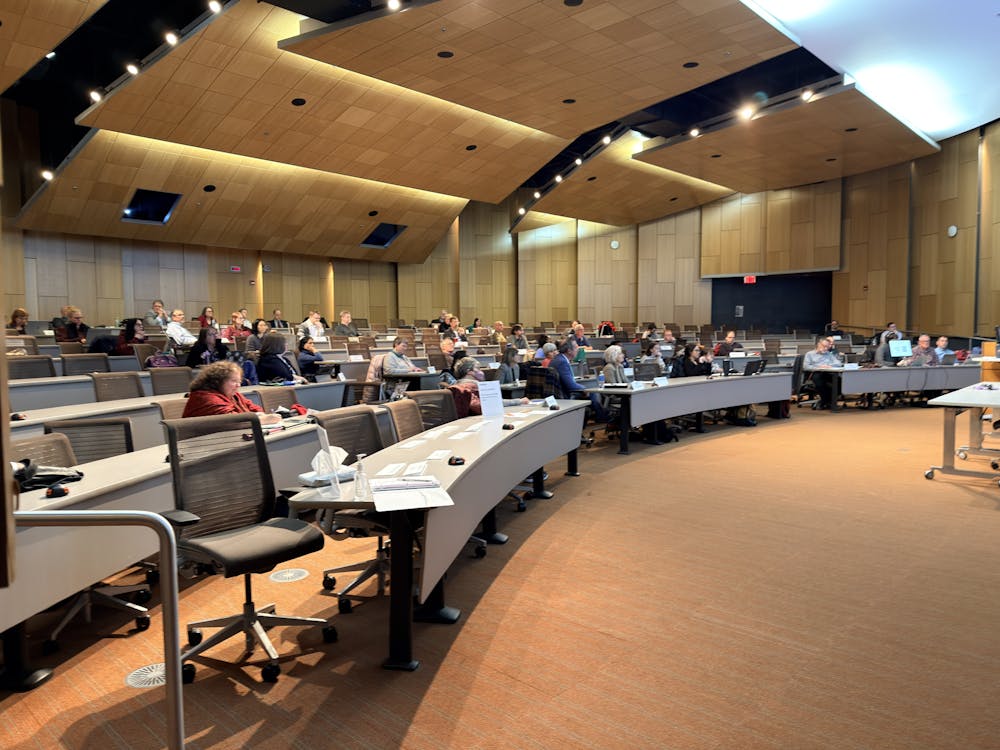
The Academic Senate meets in the French Auditorium on the Central Michigan University campus.
Central Michigan University might see personnel cuts as the university grapples with steep international enrollment losses, CMU officials told the Academic Senate on March 3.
President Neil MacKinnon said the university has dropped from roughly 1,700 international students a year and a half ago to fewer than 1,000 this year after federal visa changes allowed only 40 of 672 expected students to enroll.
The decline has created what he described as a structural budget gap due to federal policies.
"Changes to federal policies affecting international student visas have prevented a significant number of prospective international students from joining our university community," he said.
"These enrollment declines, coupled with rising operational costs, have contributed to a gap in the university's base operating budget. Ignoring these international student enrollment challenges, inflationary pressures are expected to continue."
Senator Grace Vandemark, faculty in the School of Politics, Society, Justice and Public Service, asked the administration whether faculty and staff positions would be affected.
MacKinnon acknowledged the likelihood, noting that personnel make up the majority of the university’s base budget.
“It's going to be a really hard number to reach without given that's overwhelmingly our top recurring expense,” he said, referring to staffing reductions as part of the solution.
Other senators voiced concern about the long-term strain.
Senator Kirsten Weber, faculty in the School of Communication, Journalism and Media, questioned whether the shortfall would continue into next year.
MacKinnon said that declines are expected to continue before stabilizing at a significantly lower level.
Senator Lawrence Lemke, faculty in the Department of Earth and Atmospheric Sciences, emphasized the toll of repeated budget reductions.
“Seven years of consecutive budget cuts have been very difficult. They hurt,” he said. “We’ve cut to the bone.”
MacKinnon responded that advocacy efforts are ongoing, including conversations with elected officials and coordination with other public university leaders in Michigan.
“This is a national issue. This is not a CMU issue,” he said, noting the ripple effects on the local economy as well.
Following discussion of budget concerns, the Senate turned to another major issue: proposed changes to the university’s general education framework, known as Central Education.
Changes to the general education
The first set of changes focused on updating the Curricular Authority Document (CAD), the university’s main curriculum policy document, which outlines how courses are reviewed and approved. The goal was to clean up the language and make sure the written rules match how things are actually done today.
One of the biggest changes would be to build general education requirements directly into the course approval process. Instead of filling out a separate form explaining how a class meets general education standards, departments would include that information as part of the main course proposal.
A proposed amendment from Senator Lemke sought to soften wording in the document, changing language that required courses to show how student learning outcomes “will be addressed” to language suggesting they “could be addressed.”
Lemke argued the shift would give instructors more flexibility in how they structure courses.
“I would like to give our instructors the latitude to construct a course that meets the learning objectives in a way that fits their style of instruction,” Lemke said. “I don’t think we should demand in the CAD that everything has to be exactly what it says in the mix.”
Other senators disagreed.
Senator Rachael Nelson, faculty in the School of Health Sciences, opposed the proposed wording change, she said courses must clearly meet student learning objectives in order to qualify as general education.
"I would not be in favor of changing to could or could be because it defeats the purpose of making sure the course fits within the General Education," she said.
Senator Lemke defended the proposal as a compromise aimed at easing pressure on high-credit majors, arguing it would be “a more elegant solution” that still prioritizes student preparation.
The amendment ultimately failed 32-15.


