'It’s an incredible experience'
A glimpse into the journey of international student-athletes
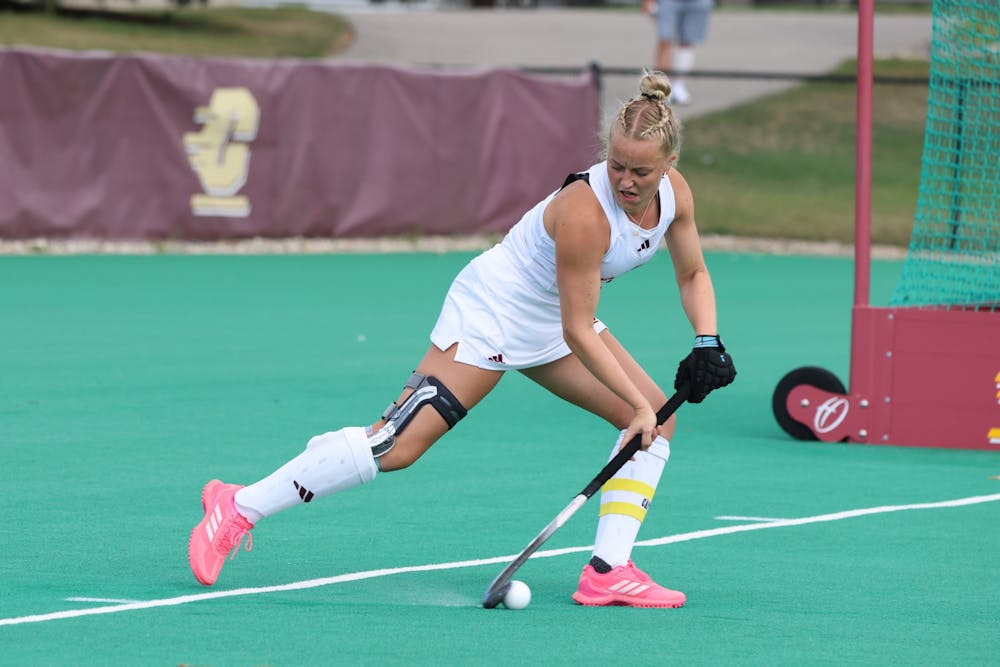
Central Michigan University senior forward and midfielder Amelia Lane passes the ball back into the game at Cristy Freese Field on Sunday, Sept. 7, 2025. Lane scored no goals with no attempts. (CM Life | Jasmine Brookins)
For Central Michigan freshman field hockey player Pleun Van Gent, obtaining a visa to come and play her sport in the United States wasn’t easy.
Van Gent was unable to schedule a visa interview in her home country of the Netherlands. Instead, she was forced to travel into a different country to obtain one.
There are currently 22 international student-athletes at Central Michigan University representing nine sports and eight countries. Those countries include England, Costa Rica, the Netherlands, Austria, Argentina, Canada, India and Spain.
The process of getting a visa is just one of the many things international student-athletes face when coming over to America to go to school and play their sports. Athletes also have to deal with the language barrier and cultural differences, all while being far away from home.
The visa process
CMU works with two different types of visas for international students. According to the Director of International Student and Scholar Services Kim Morrison, the most common type of visa used at CMU is the F-1. Morrison said the F-1 visas are used by students who are looking to complete their degree.
The other visa CMU accepts is the J-1. Morrison said the biggest difference between the two visas is that the J-1 is more of a short term option.
“It’s just a little different whether it depends on the period of time they stay, whether they are seeking for their degree or not,” Morrison said.
For international students seeking an F-1 visa, there are two main steps that have to be completed before they are allowed entry into the United States.
First, the student must get accepted into a Student and Exchange Visitor Program (SEVP)-certified school in the states. Once a student does that, they need to receive a Form I-20, Certificate of Eligibility for Nonimmigrant Status.
The Form I-20 is simply a paper copy of the student’s information that is included in the U.S. government’s database for students and exchange visitors. This form proves that the student has been admitted into a school in the U. S. and is eligible to apply for an F-1 visa.
To get the visa, the international students can apply for it at a U.S. embassy or consulate. Morrison said that scheduling a visa interview is the most difficult part of the process for international students because interview slots are limited.
“We have process(ed) many application(s), we have issued many I-20s, but the spot… where they got stuck is they can’t even schedule for their visa interview,” Morrison said. “It depends on the country, but I see it’s getting more difficult to get the slot.”
Morrison said that if the visa gets approved, the student is ready to come to the U. S.
While Van Gent had a difficult time getting a visa, other athletes, like fellow field hockey players Amelia Lane and Lola Pardo, got through the process much easier. Lane, a senior from the United Kingdom, said she didn’t have to go to an in-person appointment.
“They didn’t ask me to go, which was helpful because it was far from where I lived,” Lane said. “It worked out easy for me. I just filled some stuff out and they sent me what I needed.”
Likewise, Pardo, a freshman from Argentina, didn’t have a problem getting through the steps.
“It was easy for me,” Pardo said. “It was fast, it was effective, as I was expecting.”
Why America?
For some international athletes, coming to America gives them a better opportunity to play their sports while completing their studies.
For junior track athlete Andrea Merin, who came to CMU this school year, participating in her sport while also going to college in America is much easier than in her home country of Spain.
“ I run when I was in Spain, but it’s much more difficult because universities don’t understand that you want to run,” Merin said. “They only understand that you have to study, and you don’t have any support. It’s completely different from here because here your professors help you. You can change your exams, and your schedule is in order of when are your practices. But in Spain, it’s different. If you do a sport, they don’t like you.”
Lane echoed with a similar statement.
“Back home, university has the sport, but it’s very, very focused on academics,” Lane said. “Here, I feel like I’ve been able to balance both perfectly, how I’d like them to balance rather than having to focus solely on one. … I think America does it very well.”
Lane also said that the support system given to student-athletes in America is better than what she has experienced back home in the United Kingdom.
“Back home, it’s practice and games,” Lane said. “I feel like here, there is more practice, more nutrition, more lifts, more behind the scenes. … Everything behind the scenes is much bigger here, I believe.”
The athletic training in America is one of those behind-the-scenes systems that has stood out to Lane, who tore her ACL in her sophomore year at CMU.
“Athletic training is so good here,” Lane said. “Through my knee and everything, I couldn’t have done it without the athletic training staff here. You don’t get that back home. It’s not on the same level. It’s good. I’m not saying it’s bad, but it’s not on the same level.”
Van Gent said she decided to come to America to fulfill a curiosity driven by her and her family’s past experiences in the country. One of those experiences was a family vacation.
“I was really curious about the United States, and we also (had) been to New York in 2023 on vacation, and I really liked it,” Van Gent said. “It’s so much different, but it’s also so nice. So when I saw this opportunity, I was like, maybe I should just give it a chance. You can always quit. … So I knew there was a way home and I just gave it a chance and I just, I love it here.”
The recruiting process
For track and field associate head coach Nathan Probst, connecting with international student-athletes has happened two different ways.
“Anybody that I’ve ever recruited that was international has either had a recruiting service reach out to us and say, here’s five people that we think might be a good fit for you, or we’ve gotten just like a direct email from the athlete themselves,” Probst said.
Pardo worked with a recruiting agency that assisted her with the process of advertising her skills and connected her with coaches in the states.
“ They basically connect with coaches here and show them your profile, your highlights video and stuff,” Pardo said. “If that coach is interested in you, they just talk to you straight.”
One notable difference between domestic and international recruiting is that international student-athletes don’t always get to visit a school before they choose to come.
“I think I’ve had maybe, in my like 15 years of coaching, I’ve had only a handful of international athletes visit,” Probst said. “ When we get kids on campus and they get to meet the team and spend time with the staff, that really goes a long way in getting to know their character. So it’s a little bit harder to determine that with just phone calls. So, maybe from a time perspective, it just takes a little bit more to know that that’s somebody that we wanna commit to.”
Because Van Gent didn’t get a chance to actually visit Central Michigan in-person, she had to resort to other ways of scoping out the school.
“ I never visited, so it was hard for me to decide… from the other side of the world for university, but I saw pictures and I did research and I liked it,” Van Gent said.
Adjusting to a new country
For student-athletes coming to America, one of the problems they may run into is adjusting to the language barrier. Despite taking English classes in high school, Merin said she came to CMU having not studied the language during her two years at university in Spain.
“At first, (it) was difficult,” Merin said. “But now I think that I can understand very much and I am trying to learn very much speaking and writing. That is the hardest thing.”
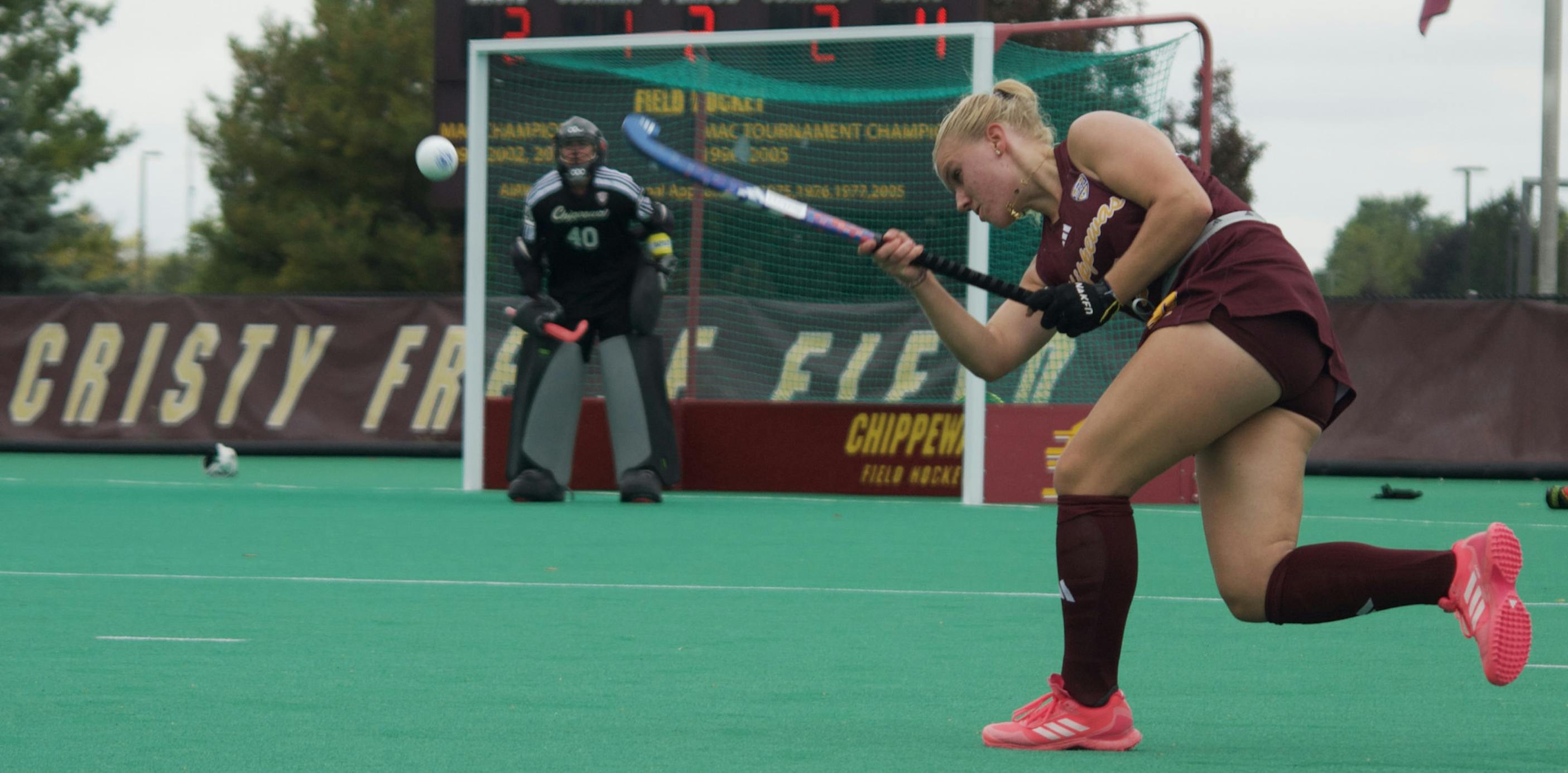
CMU freshman defender Pleun Van Gent hits the ball during field hockey at Cristy Freese Field on Friday, Sept. 19, 2025. In support of International Students' Day, fans learned that Van Gent is from the Netherlands. (CM-Life | Soli Gordon)
Van Gent also struggled at first with the language barrier. For one, she faced difficulties in the academic realm.
“When classes started, I felt pretty scared because I obviously had class in English before, but not like this, this was every class,” Van Gent said. “And also, it’s hard to read and ask questions in English. So that was pretty hard for me the first couple week(s) of classes to understand what they’re saying. Also, they talk really fast, so it was hard to understand, but you adjust to it pretty easily.”
Van Gent said she also had to adjust to the terms used by her field hockey team.
“I didn’t have a single clue what my coach was saying at first, so I was pretty confused during practices,” Van Gent said. “And also during scrimmages and games, I didn’t know what was going on.”
International student-athletes also have to adjust to different cultural changes, including changing the times they eat.
“The time to eat also is very difficult because you have lunch like at 11 (a.m.), and it’s a small lunch, but in Spain it’s the big meal,” Merin said. “It’s huge, and it’s like at two or three, and then we have dinner at 9:30 or 10. And here, the cafeteria closes at 7:30. So at first, I didn’t have dinner because I wasn’t hungry at 6 (p.m.) to have a huge dinner.”
The time difference between America and these international student-athletes’ home countries can also pose a hardship.
“The time difference is six hours from the Netherlands,” Van Gent said. “So when I wanted to call my parents or my family or my friends, they were all asleep. … It wasn’t that I really, really wanted to go home, but I just wanted to talk to them when I had the time, but I couldn’t ‘cause it’s the time difference that makes it hard.”
“That is probably the biggest difficulty when you talk about missing home or trying to connect with home,” Lane said. “The time difference isn’t ideal. But I think again, it’s something I’ve learned to live with.”
‘Do it’
Despite the challenges they faced and the adjustments they had to make, the message from these four athletes to other international student-athletes is clear.
“Do it,” Lane said. “Absolutely do it. … If there’s a small part of you that wants to do it, even if you’re nervous, do it, because I’ve never looked back and regretted it.”
“Just do it,” Van Gent said. “Go for it. Take your chance. I know it sounds scary. … It sounds so weird, but just do it and you won’t regret it.”
Similarly, Merin said language gets easier in three or four months and everyone is open to help. Pardo echoed the same sentiment.
“It’s an incredible experience, and if you end up not liking it, there’s always a flight back,” Pardo said. “Maybe the process sometimes gets a little rough and there’s gonna be things that get in the way, but you can handle everything. Go with it. Go for it, and achieve it if you really like it.”


