Think dollars are the ultimate measure of success? Think again
With over 200 academic programs, Central Michigan University officials said they are always looking at the curriculum and adapting the programs to be as effective as possible. At the same time, they said there is no single definition of success.
Revenue, however, is not a measurement of success, said Dave Patton, the senior vice provost of academic affairs. That’s because CMU is a public university, which means it’s a nonprofit.
“We don’t have to make a profit,” Patton said. “What we have to do is ... manage all of these programs and all of the revenues and expenses so that it breaks even in the end. … We don’t have to judge a program as harshly as maybe a for-profit might.
“We often have our judging programs and the offerings we make through the lens of service to the population of the state of Michigan.”
An example of a program at CMU that serves the state is nursing. In 2025, students at CMU took 378 credit hours in nursing, compared to the 21,143 credit hours that teacher and special education offered, according to the data from CMU. First class of nursing students began in Fall of 2025, after CMU launched the program in 2024.
“We can only admit so many students for accreditation reasons because we also have to have the ability to place them in clinical settings in which they can practice,” Provost Paula Lancaster said.
In addition, Ray Christie, senior vice provost of Academic Administration and Resources, said even though a program might not have many students, it could offer courses required for other majors.
“People would say, ‘Well, gee, it’s a small program. We could save money,’” Christie said. “Well, many of the courses required for that small program have to be offered to fulfill other programs. … We would literally not be saving money, because … many of the courses still have to be offered to meet other program requirements.”
Besides the public service, Patton said some other factors of a successful academic program are student demand and placement rate for alumni.
According to the data provided by CMU, the top programs based on the credit hours taken by students in 2025 are:
- Teacher and Special Education: 21,143
- Interdisciplinary – College of Business Administration: 18,613
- Business Information Systems: 17,244
- School of Communication, Journalism and Media: 16,282
- English Language and Literature: 15,689
The programs with the highest number of graduates from 2024-2025 are:
- Master’s in Information Systems: 449
- Bachelor’s in Psychology: 148
- Doctor of Medicine: 96
- Bachelor’s in Biology: 74
- Bachelor’s in Communication Development: 70
Changes to academic programs
To respond to the market demand or student interest, there’s a process to add new programs at CMU, Patton said.
“The norm is (the idea) comes from the faculty in the colleges, and they propose new curriculum,” he said. “They may be responding to student demands. ... Once we ... go down that path of a decision, we have to answer a bunch of other questions.
“If we do this, is there market demand for the students once they get our degrees? ... Do we have all of the necessary resources to offer a high-quality program? And that involves faculty, the equipment space and, in the case of something like nursing, external partnerships.”
Once CMU decides to start a new program, it puts a regular review in place.
“(Programs) have to do an annual assessment,” Patton said. “But then at the end of the seven years, they do a broader review, and we even bring in external people from other universities and from industry to come in and evaluate how is our program going. And they do look at things like … enrollment, they’ll look at success rates, if there are external exams, for example, that the students have to how well are we doing.”
An academic program can also be cut for different reasons, such as external factors. For example, Patton said in 2020, the state of Michigan changed certification bands for pre-K through 12 schools.
“That meant we literally had to create all new education programs and delete all of the old education programs,” he said.
The cost of academic programs
Currently, CMU offers over 200 programs across seven colleges, but their revenues and expenses differ.
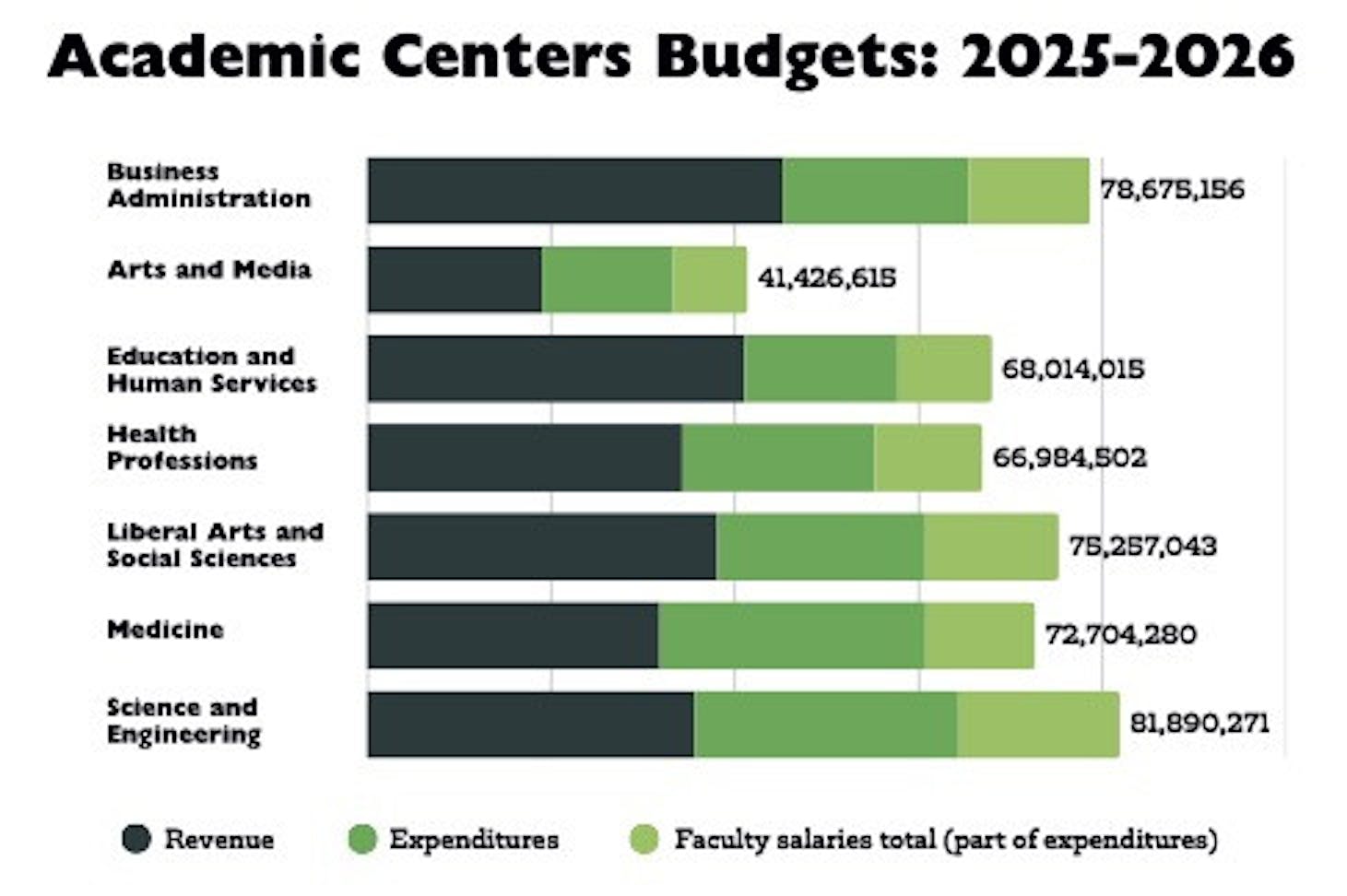
According to the 2025 Operating Budget, the Business Administration college brings the most revenue for the university— over $45 million. Its expenses are over $20 million.
The college with the lowest expenses is Arts and Media—over $14 million. Its revenue is over $19 million.
The highest expenses belong to the College of Medicine, with—over $28 million. Its revenue is over $31 million.
Christie said different disciplines have different costs of instruction. CMU charges one tuition price, but some majors require more expensive equipment, labs and modes of instruction.
Professor salaries are a part of the colleges’ expenses. For example, in total, the College of Science and Engineering spends the most on its faculty salaries, which is over $17 million. The College of Arts and Media spend the least, over $8 million.
The biology program, which is a part of Science and Engineering, has one of the largest numbers of tenured professors, at 24. History, World Languages and Cultures has 24 tenured professors as well, while English Language and Literature comes third, with 23 tenured professors.
Professors become tenured by being successful and demonstrating their expertise in the field, Christie said.
“Different programs have different needs,” Lancaster said. “A program in which we have our students out in the field doing clinical work or experiential work ... often does require or need more fixed-term faculty or even part-time adjuncts, because they are typically closer to the work of the profession, the work out in the field and can provide that support.
“Biology is one of those majors that is also used as a launching point or launching place for all sorts of graduate degrees. ... So those faculty having tenure ... who are participating in research and will invite students into their labs to do research alongside them, is really important for student success.”


