Combating enrollment decline
CMU addresses enrollment decline with online learning
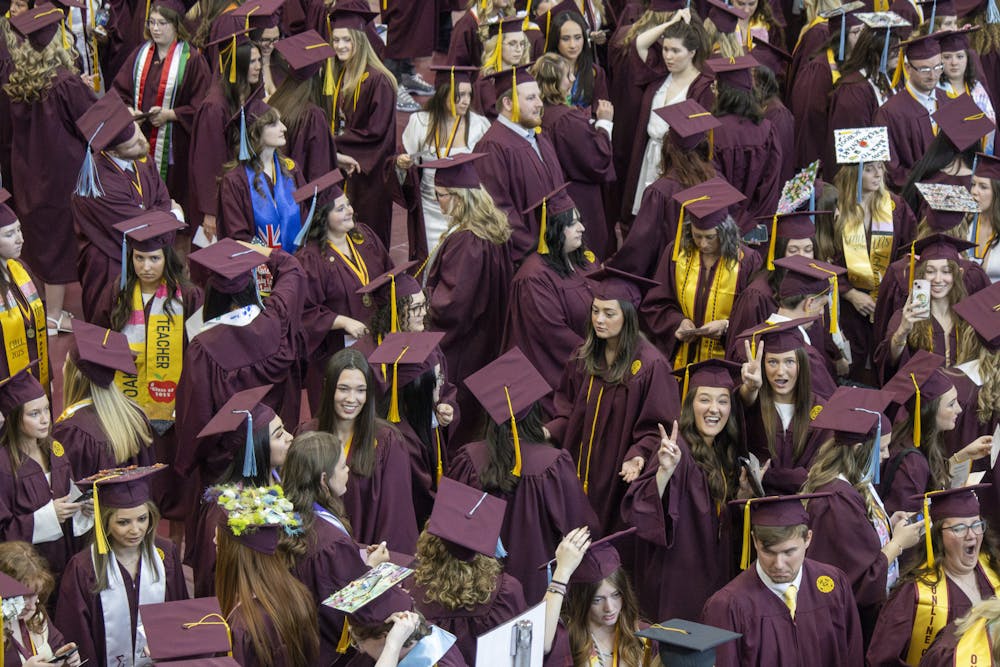
Central Michigan University’s enrollment has dropped by over 10,000 students in the last 10 years. This drop has brought enrollment to nearly the same level as it was in 1970, when CMU had 14,112 students.
Jennifer DeHaemers, vice president of student recruitment and retention at CMU, said enrollment fell because of causes like competition, slow changes to modernize online learning, demographic changes and a devaluation of education.
The university reached its highest enrollment ever in 2015 with 25,528 students. At the end of 2025, it reached 14,171, according to CMU enrollment reports.
Central, along with others in Michigan, grew complacent from having high enrollment numbers, DeHaemers said. When enrollment started to drop, the university expected to recover in the following years, but numbers continued to decline.
The Michigan Association of State Universities coordinates 15 Michigan universities. Its data shows that 12 of the universities, including CMU, declined in enrollment and 35,080 students in the last decade.
“I think what happened is that certainly the people that were leading enrollment effort were not putting the right things in place to counterbalance that (enrollment decline),” DeHaemers said.
She said the university also faced a 15% budget cut in 2020, which resulted in staff, faculty and administrators being cut across campus.
“We’ve not really recovered from that,” DeHaemers said. “I think the staff (is), in many areas, very stretched, very thin.”
The budget cut happened largely because of both the COVID-19 pandemic and enrollment decline, Joseph Garrison, CMU Budget Officer, said.
The university has been trying to modernize itself, such as updating the university’s online program, Innovation Online, to combat enrollment decline, Dehaemers said.
Garrison said CMU has had the infrastructure for its online program to help with its growth.
He said the university had been working on its online program for many years, especially during the decline in enrollment during the 2010s, but the pandemic helped the university see how viable it was.
“We are looking to offer more programs online with a persistent intention to grow, in the neighborhood of 5% to 10% annually for the next five years,” Patrick said.
To get an idea of this, there are currently 3,383 students in IO, according to enrollment reports. An increase of at least 5% would mean that CMU should have around 4,300 students (nearly a 1,000 student increase) in five years.
CMU has always had a long-distance/online program, but has fallen behind and faced competition, DeHaemers said.
The university’s long-distance learning originated through learning packets being mailed during the ‘70s, but has changed with the development of technology to reach everyone, said Kaleb Patrick, vice president of IO. The university also used to have in-person classes at military bases. Now it only has one at Fort Leavenworth, Kansas.
“(Other universities) moved very quickly into online. They hadn’t done very much long-distance where it was slower for us to modernize,” DeHaemers. “Making that transition was a little slow, so that hurt with the enrollments as well when we lost personnel in the Global Campus.”
DeHaemers said society has also changed since the ‘70s, where CMU’s targeted demographic and the public’s value of a higher education have both changed. She also said that there are fewer high school graduates going to college.
“Over the last probably 15 or 20 years, there’s been a really hard devaluing of education in the United States,” DeHaemers said. “A lot of people (are) questioning, is it worth it?”
In a survey conducted by Pew Research Center, about 49% (2,549) of Americans say that a four-year college degree is less important to getting a well-paying job compared to 20 years ago.
By having CMU expand its online program, it can reach a larger demographic for enrollment.
Alongside CMU’s online program, the university has a Strategic Enrollment Management plan.
It consists of 33 strategies that aim to combat enrollment decline. For example, the university is the first in Michigan to promise students a job or graduate program within six months as part of the Central Career Guarantee initiative.
In addition, universities across the U.S. are competing for international students.
Garrison said he has seen international students who have gotten their visas go to other universities, like Michigan State University (MSU).
MSU faced only a slight decline in international students from 4,768 to 4,589 in the fall of 2025, reported by The State News. Comparably, CMU experienced a larger enrollment decline from 1,659 to 1,204 in 2025.
DeHaemers and Garrison also said no university has been doing well with international students and has contributed to the enrollment decline. However, online learning has given a few international students the ability to attend classes.
The university doesn’t want to leave international students out, even though visas are difficult to get, and some students have gone through online, but understand why others chose not to, DeHaemers said.


