CMU leadership responds to former Trustee's concerns on enrollment, College of Medicine
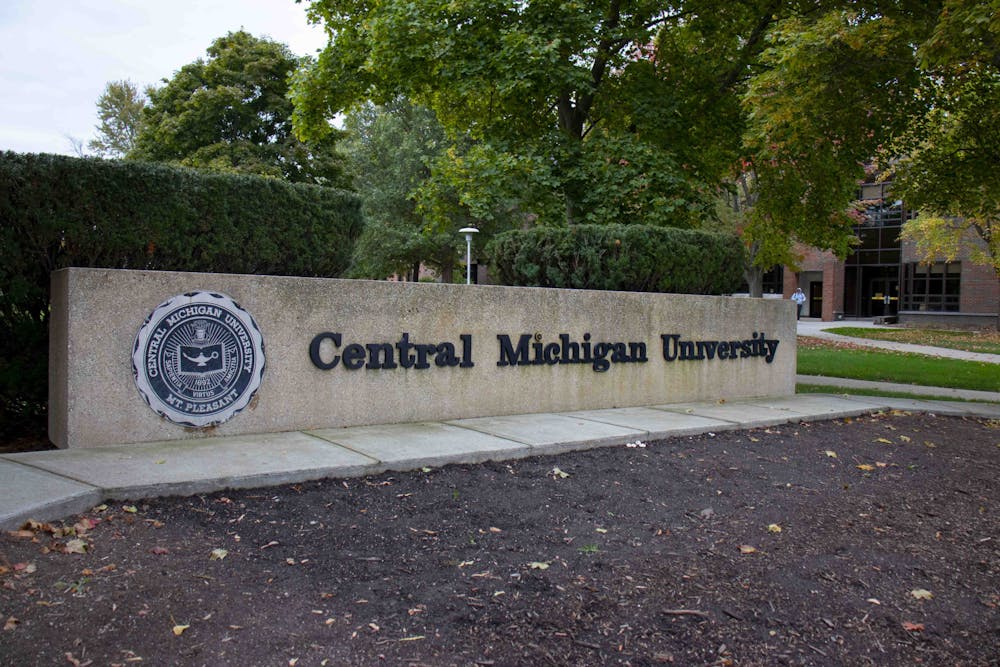
Central Michigan University showcases a sign behind Warriner Hall, Friday, Oct. 17, 2025. Every day, students and faculty walk by the sign on the way to class, home or work. (CM-Life | Mary Nowosacki)
Former Central Michigan University Trustee Todd Anson wrote that presidential leadership at CMU allowed the university’s decline in a column in Midland Daily News on April 19. He also wrote that the current CMU Board and President Neil MacKinnon are “ill-equipped” to address the financial challenges the university faces.
Central Michigan Life sat down with Anson, MacKinnon and Chair Denise Mallett to understand these concerns and where the university stands.
During his interview, Anson said one of his biggest frustrations with MacKinnon’s leadership is the decision to scale down the project of moving the College of Medicine (CMED) to Saginaw.
The opportunity CMED offers is leading rural healthcare education and helping the Saginaw-Midland market to embrace CMU, Anson said.
CMU announced its plans to move CMED to Saginaw in July 2024. CM Life previously reported that the project’s fundraising goal was expected to be $200 million, with plans to move by 2028. More than a year later, CM Life reported the new goal of $100 million, with $80 million already received in gifts from Covenant HealthCare and MyMichigan Health.
Anson said the current university leadership ignored the vision and efforts of him, former CMED dean George Kikano and CEO of CMU’s Medical Education Partners Samuel Shaheen to develop this project.
“There was a significant missed opportunity by him and his team, whom I call parochial thinkers,” Anson said. “The president never once asked me or Dr. Shaheen, not one question about the structure, its benefits, any possible negatives and the confidence we had in the fundraising. And instead, he chooses a much more diluted and less viable option with significantly less money on the upside and has yet to explain to anybody.”
In response to Anson's op-ed, Chair of CMU's Board of Trustees Denise Mallett and MacKinnon told CM Life in an interview that, after reviewing the university's plans for the college and seeking advice from an external fundraising firm, the board and the president believed the $200 million goal was too high.
"It was actually Trustee Anson's last meeting as a board member (February 2025), where (CCS fundraising) said $200 million was just too large of a target," MacKinnon said. "When they talked to prospective donors and foundations, it would be an extreme stretch to reach that. So they recommended a refined goal of $100 million."
Since they established the new goal for the college, MacKinnon and the board have approved $1.2 million to pay for specialized fundraisers and project developers, approved contractual conversations with Clark Construction for the building and are currently searching to fill the CMED dean position.
MacKinnon said the university is focusing on strengthening its partnership with Covenant HealthCare and MyMichigan Health.
"The other part we are working on since I was president is really striking the partnerships with those two big health systems, because again, we don't own our own healthcare system," MacKinnon said.
Anson said the original $200 million goal was supposed to be raised by the city of Saginaw.
“Saginaw was going to raise 200 million plus, and the state, … the city and county were going to contribute up to another 70 or 80 million dollars to entice CMU to locate its med school,” Anson said. “There was not a CMU fundraising project. It was actually a challenge for Saginaw, that is a conditioned precedent, a predicate.”
Executive director of strategic communications at CMU Ari Harris wrote in an emailed statement that CMU and its Board of Trustees are responsible for setting the budget and ensuring funds for the CMED.
“In the early phases of the project’s proposal, many leaders used variations of the phrase ‘Saginaw will be responsible for raising the money for the project,’ but that did not specifically mean a contractual obligation from the City of Saginaw or Saginaw County leaders,” Harris wrote. “Rather, that phrasing referred to the generous offers of support from numerous Saginaw-based individuals, organizations and companies who verbally pledged their help in bringing this vision to fruition.”
Saginaw's city manager did not immediately respond to CM Life's request for a comment.
In addition, Anson said it was a poor decision to move the project from its original location on the riverfront in downtown Saginaw.
“It's a dynamic area downtown, and the President and his neophyte team, completely ill-equipped to analyze this, the real estate aspects and the finance aspects of this project, made a disastrous decision,” he said.
MacKinnon said that the change from the initial location is to allow students to be closer to other hospitals in Saginaw.
"If you look at pretty much any medical school in the country, or certainly the vast majority, they're located next to a hospital," he said. "It's a lot easier for faculty and students to go back and forth."
The CMU MyMichigan Health Medical Education Building, which houses CMED, will be located on the of campus of MyMichigan Medical Center in Saginaw.
Enrollment concerns
Another challenge that CMU faces is enrollment. The university has been experiencing a constant enrollment decline throughout the past 10 years, dropping from 24,445 students in fall 2016 to 13,244 in spring 2026, which is an over 45% decrease, according to the university’s enrollment data.
“We're now at the point where CMU is in a critical stage, a critical place,” Anson said. “It can't lose more students. It needs to build positive for the future.”
Both MacKinnon and Mallett stated that enrollment growth is an issue many universities across the state and nation are facing, particularly regarding international students and visa denials.
One of the main priorities for MacKinnon's administration has been implementing a strategic enrollment plan, which outlines 34 strategies for increasing enrollment at CMU. MacKinnon said he is confident in the plan and is positive about the future.
"Right now, it's a little early, but we're projecting the largest increase year over year in domestic enrollment since 2009-10, 16 years," MacKinnon said. "There's an awful lot of optimism and good things happening."
Today, it’s important for CMU to invest in differentiating itself, Anson said. For that, CMU’s leadership needs to have curiosity and think big.
“We cannot be a mini MSU, what we were once perceived to be,” he said. “CMU desperately needs to differentiate itself in a shrinking and complicated market. … If CMU's minds are closed, its doors will soon follow.”
Specifically, Anson said, CMU needs to figure out its identity and strengths. For example, he said its colleges of business, education and medicine are successful.
“We need to invest in those because the central and upper lower peninsula of Michigan desperately needs healthcare,” he said. “They (CMU’s administration) need to listen and execute. … The healthcare market in the city of Saginaw are telling us we have a screaming, dying need for a big, magnificent, meaningful, powerful CMU presence in our community, and we will pay hundreds of millions of dollars for it.”
According to the 2025 Operating Budget, the college that brings the most revenue is Business Administration, with over $45 million. Its expenses are over $20 million.
Arts and Media has the lowest expenses, with over $14 million. Its revenue is over $19 million. The College of Medicine has the highest expenses, over $28 million. Its revenue is nearly $32 million.
MacKinnon said he recently created a University Transformation Office to look at how CMU can be more innovative. The university community can submit proposals for projects that improve CMU to win funding for their implementation.
Looking into the future
In the op-ed to the Midland Daily News, Anson proposed a solution—a blue ribbon panel.
“Our governors need to wise up and start appointing people (to the Board of Trustees) who have a personal, deeply personal relationship with CMU, either from the town and attended the school, and they haven't done that because they've played the game of political patronage,” Anson said.
Similarly, as CMU prepares for budget cuts, Anson said CMU should start with cutting administration, as he believes there are “way too many” administrators.
“It's what happens in every organization that fails, he said. “The people, the white-collar people, don't look in the mirror and cut themselves.”
MacKinnon said he already reduced the size of his cabinet by two members.
"I'm always looking at those positions," he said. "We, of course, just had an announcement, ... another VP that just resigned. And so I'm not automatically filling that position. I'm taking some time to decide whether we truly need another vice president of marketing communication. ... It is something that I take seriously."
According to the data provided by CMU, as of April 2026, the university has 46 senior officers. In comparison, it had 43 senior officers in April 2024. Senior officers are employees with senior executive responsibilities on and off-campus. These positions are determined by the President and can be terminated at any time.
Some of those senior officers also serve on the President’s Cabinet. It currently consists of 13 members.
There’s also a definition for professional and administrative staff, who are academic advisors, the counseling center, residence life, the office of admission and others. They are not unionized and work hourly or salaried, full or part-time, performing administrative and professional work. As of April 2026, CMU has 917 of these positions (including filled and vacant positions).
In general, Chair Mallett said she feels that CMU is on track for delivering its mission and that the changes CMU experiences are "energizing."
"Our mission statement says we are defined by the success of our students, alumni and our collective impact on the communities we serve," she said. "We measure our success by how well we help our students achieve their academic goals and personal dreams. Our reputation is carried by this, our amazing alumni and their professions and how they connect with our community.
"It is very important for us to be inclusive, welcoming and supportive, and we want, we want everyone, including faculty, staff, alum and students and all of our partners that work with CMU to thrive. And that's what our identity is."
Editor's note: This story was updated at 11:30 a.m. on May 21 to clarify that Central Michigan University's College of Medicine will be located on the campus of MyMichigan's Medical Center in Saginaw.


