Are there Flock cameras on campus? Police Department says no
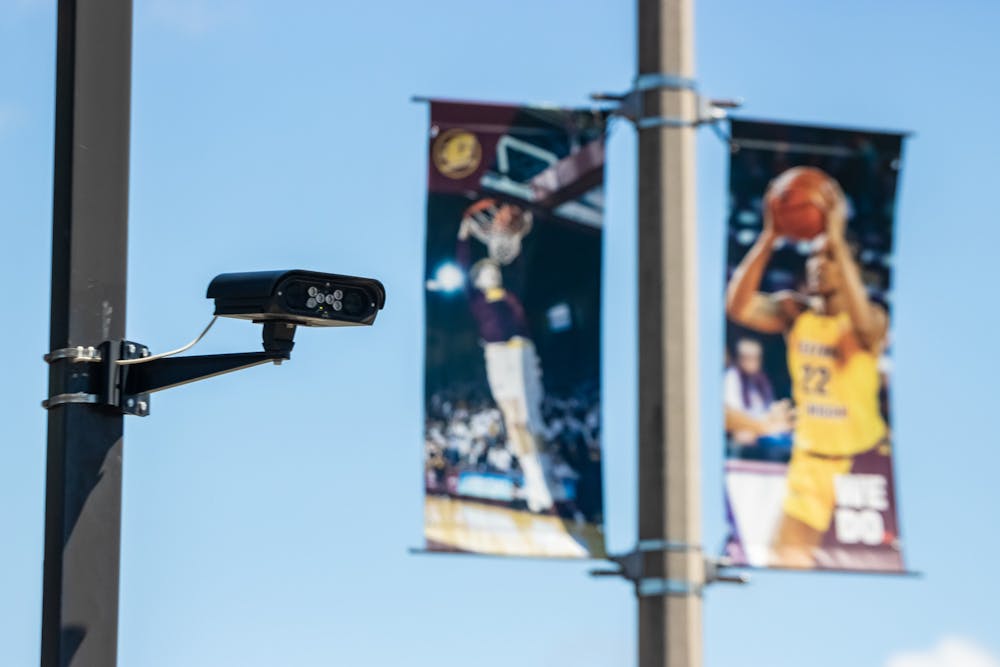
A license plate reader camera sits outside of Beddow and Thorpe Hall on Central Michigan University's campus on Monday, Aug. 24, 2026. (CM-Life | Trevor Sparks)
Driving down Broomfield Rd., you may have noticed two black cameras that line each side of the street, with both pointed at passing cars.
As fears grow nationwide about automated license plate readers and the growth of surveillance in the United States, questions have been raised on social media about two cameras on campus.
The cameras appear on the popular web service ‘DeFlock,’ which is commonly used to mark the position and model of surveillance devices to keep local communities informed.
The Department of Homeland Security‘s website states that automated license plate readers are used to compare license plate numbers against databases in order to create a record of vehicle activity, with Flock Safety being no exception.
Flock Safety is one of the largest manufacturer of these cameras and according to the organization‘s website, automated license plate readers have contributed to solving 700,000 crimes, leading to criticism over its proximity to law enforcement and how the data gathered is stored.
The 'DeFlock' website states that "captured vehicle data is uploaded to Flock's cloud system, where participating agencies can search and share information across jurisdictions."
However, the Chief of Police with the Central Michigan University Police Department, Cameron Wassman, said these cameras are not the work of Flock or other third party agencies, but rather the same license plate readers that Parking Services have been using since 2022.
”We have had cameras on this campus in varying levels for probably 20 years or more of that time,” Wassman said. “We are fortunate that CMU has the IT staff that is able to install and maintain and do all that sort of work in-house.”
The cameras stand as two of 17 license plate readers on campus, which police said are instrumental in ensuring campus safety.
"We've been able to solve a number of crimes using these cameras that have been in place over the years ranging from smaller theft type things to helping catch homicide suspects from other jurisdictions that have traveled through our campus," Wassman said. "So that is the benefit of it."
CMUPD said the cameras along Broomfield Rd. do not carry many of the features commonly associated with Flock surveillance.
“Also important to point out, that certainly the technology is out there in the world, but our system does not have the capability to do human analytics,” Wassman said. “It does not do facial recognition… we are mostly focused on vehicles with this sort of thing.”
CMUPD has also said that the data collected by the cameras is secure and stored on campus.
“Nobody outside of CMU has access to it, unlike some of the companies, we do not sell the data and we do not allow anyone else to get at it,” Wassman said. “IT are the ones that maintain the system and the police department are the ones who have access to the system.”
Additionally, in a follow-up statement issued to Central Michigan Life, Wassman said that the data is also inaccessible to the company who made both the hardware and software that the cameras operate on.
The police department said it maintains a strict policy about what data can be retrieved from its system.
”It is strictly audited by policy, our department dictates times when our data can be accessed and what it can be used for,” Wassman said.
CMUPD said that data from the cameras are accessed only when probable cause has been established.
”The keywords are ‘in conjunction with a criminal investigation,'“ CMU Deputy Chief of Police Michael Morrow said. “We have to have probable cause that a crime was committed before we‘re even going to have a reason to look into that system to gain information.”
Additionally, the data procured from the cameras are not stored in the cloud, but rather the CMU servers which Wassman said are ‘cyber secure.’
Even with the precautions taken into account, Wassman and the police department remain aware of the skepticism of students who worry about their privacy and safety with these cameras.
”I think it is important to differentiate things, it is an in-house system maintained by CMU people," Wassman said. "It is not managed by a third party as far as data management or installation goes. It isn’t so we can watch in on people, and spend our day seeing what people are doing.”
For more information about Central Michigan’s policy on license plate readers, the policy is listed on CMU’s website.


