Trustees hear public concerns about latest enrollment numbers

In their September formal meeting, the Central Michigan University Board of Trustees offered an optimistic view on enrollment trends heading into the 2026-27 academic year, but were met with deep concerns from community members about what these numbers mean for the future.
Fall enrollment data
Trustee Regine Beauboeuf, chair of the Enrollment, Retention and Student Success committee, said overall, enrollment has decreased this year. That's largely due to a continued decline in the international student population, which has dropped by about a thousand students in the last two years.


On the domestic side, Beauboeuf said undergraduate enrollment has remained steady. The number of new domestic undergraduate students has increased, and there was a slight uptick in new students who hail from Michigan, she said.
“While most of our peer institutions are experiencing up to double digit enrollment loss, our enrollment numbers tell a different story,” Beauboeuf said while giving her committee report. “And this story, it tells a story of achievement, hope and intentionality."
“Are we saying that we there yet? No, not necessarily, but the numbers that we are seeing, and when comparing those numbers to our peer institutions, we think CMU is way ahead.”
Her sentiment was echoed by CMU President Neil MacKinnon, who remains confident in his administration’s Strategic Enrollment and Management (SEM) Plan. He laid out his presidential priorities to the Board for consideration, with the first being enrollment and student success.
The SEM plan has 34 strategies targeted toward increasing enrollment. In an interview with Central Michigan Life, MacKinnon said the university will be comparing enrollment data to the progression of those strategies to measure the plan’s success.
“If we see certain strategies are working better than others, we will probably pivot a bit and put resources there,” MacKinnon said.
He said the university will also be assessing opportunities to expand existing academic programs that draw students in, create new ones and review underperforming programs to see if any adjustments need to be made.
Community concern
In the public comment session that followed the Board’s formal proceedings, former CMU Trustee Todd Anson, along with alumni Sid Smith and Bob Weisenburger, aired their concerns with the latest enrollment numbers.
Anson, who has authored several public criticisms of MacKinnon and the Board in the Midland Daily News, implored the board to consider taking a bold step to expand CMU’s reach in the Artificial Intelligence sector as a way to differentiate itself from other higher education institutions.
“AI offers CMU an enormous opportunity,” Anson said. “I would like CMU to consider granting $100,000 to this cause as a potential match of monies to come from within the community to help redefine the community and CMU’s relationship.”
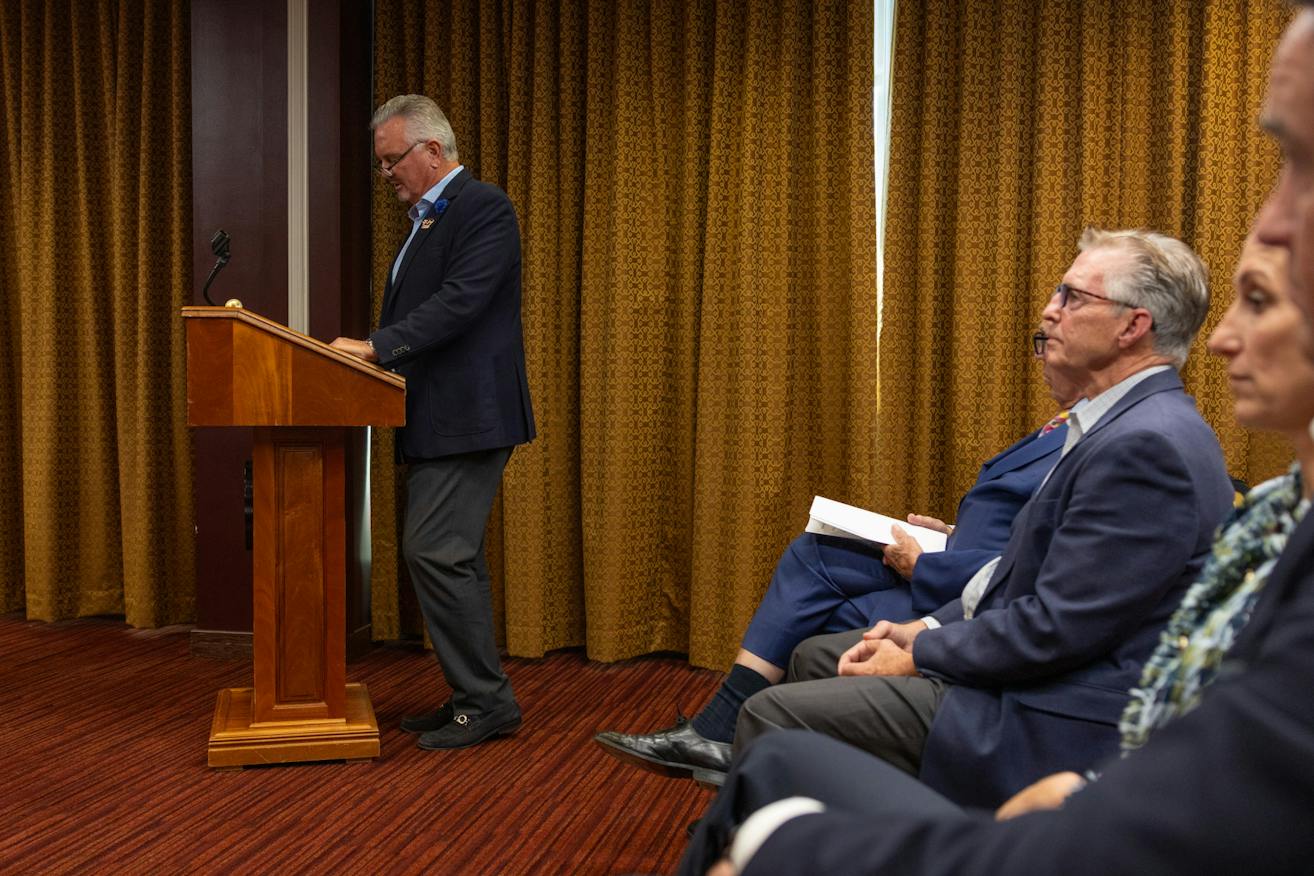
Anson said he has already started the process of communicating with community stakeholders, like the Mount Pleasant Area Community Foundation and the Saginaw Chippewa Indian Tribe, to see if the organizations would be interested in investing in such an initiative.
During their time at the podium, Smith and Weisenburger spoke about the willingness of the community surrounding CMU to help keep the university in a strong position.
“If Central goes bad, this community goes bad,” Weisenburger said. “Nothing is more important than the success [of the university]. Central doesn't have a declining enrollment problem, Central Michigan and the community have a declining enrollment problem.”
Financial implications
Before getting into the Finance and Facilities Committee report, Trustee Edward Plawecki offered his perspective on the university’s financial standing amid the struggle to bring enrollment back up.
Plawecki said CMU's financial position remains strong with a high credit rating, touting his expertise in the area given his role as chair of the committee for the last seven years.
“I can tell you CMU is and will be and will remain well prepared to address whatever future challenges we encounter going forward,” Plawecki said. “We're not going anywhere.”
The university is coming fresh off a round of budget cuts that came in response to a multi-million dollar revenue shortfall stemming from the loss of international students.
When asked if university leadership is bracing for a similar occurrence this year, MacKinnon said it’s too early to tell.
“Around January is when we start to get a sense of trying to project with accuracy what next fall will be,” MacKinnon said. “We'll have to wait and see how many deposits we're getting and things like that. By next January, we'll start to have more in-depth meetings to figure out, 'are we going to meet our targets?'”
In other news:
- CMU announced that its recently launched “Forge the Future” fundraising campaign has already received over $237 million in donations amid its five-year quiet phase. The national campaign effort will continue for five more years.
- Outside of enrollment and student success, MacKinnon’s priorities for the 2026-27 year include financial sustainability and institutional resistance, athletics and the student experience, presidential leadership and external influence as well as organizational effectiveness.


