'There will be better days ahead'
University Board of Trustees discuss declining enrollment
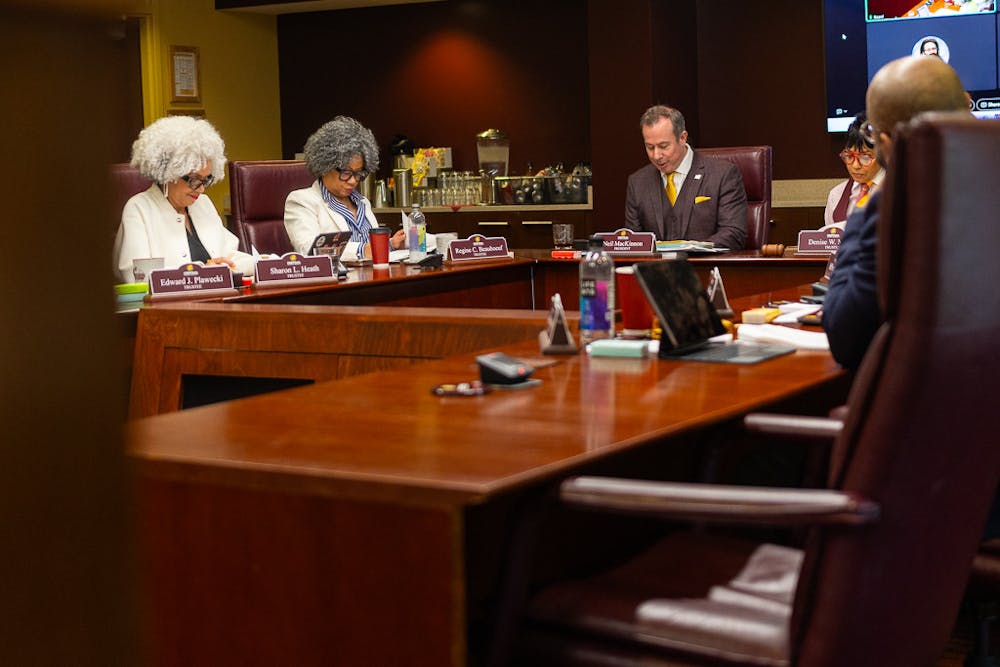
Central Michigan University President Neil MacKinnon gives his report during the Board of Trustees Meeting held in Bovee University Center on Thursday, April 23, 2026. (CM-Life | Cristin Coppess)
Vice President of Student Recruitment and Retention Jennifer DeHaemers said she and her team will be reconsidering enrollment goals made in the Strategic Enrollment Management Plan (SEM) after Central Michigan University saw another drop in enrollment this semester, during the Board of Trustees Committee meetings on Wednesday, Sept. 23.
This semester brought in 13,524 students, which is over 600 students down from last year.
The Strategic Enrollment Management Plan is a five year university plan to increase student enrollment on campus. The plan officially started rolling out projects this spring.


“I feel like we’re making great progress,” DeHaemers said about the Strategic Enrollment Management Plan. “The one thing that we do need to do is reconsider the enrollment goals that we had in the plan based on this fall’s enrollment.”
DeHaemers said there has been an increase in enrollment from undergraduate students from Michigan. She also said the retention rate between second and third year students has increased, while undergraduate enrollment has leveled with past years.
“I think enhanced enrollment and student retention is so important to the future of this university,” Vice Chair Todd Regis said.
“Really everybody on this campus should be doing everything they can to help reinforce and to help retain and enroll new students to Central.”
DeHaemers said she and her team will be meeting to assess outside factors, areas that need more attention and how things are going next Monday.
"I'm still very optimistic that we have the right plan, the right leadership with Jennifer and her team," MacKinnon said. "There will be better days ahead."
Academic and Student Affairs Committee:
CMU is expanding its partnership program, Central Bound, with community colleges and charter schools all over the state, Trustee Sharon Heath said.
Last year, CMU started a new partnership with Lansing Community College (LCC) to allow LCC students to dual enroll in both LCC and CMU. Through the program, LCC transfer enrollment has increased by 45% this year, Heath said.
She said the university is working to partner with several other schools across the state including:
- Muskegon Community College
- Mid Michigan College
- Heartland Community College
- Bay de Noc Community College
- North Central Michigan College
“Over the course of years, we’ve been speaking about our charter schools and community college partnerships, so now, all the work that we’ve done, we’re really seeing it come to fruition,” Heath said.
She said through the university’s partnerships with 70 charter schools across Michigan, the charter school student’s interest in going to CMU is growing. Admissions from students from charter schools have increased by 36%.
These charter schools are located in 16 counties across Michigan with a large concentration in four counties including:
- Wayne County with 28 schools
- Genesee County with six schools
- Livingston County with five schools
- Macomb County with five schools
In other news:
- Heath said academic integrity violations have decreased this past year, but alcohol violations, residence life policy violations and control substance violations have increased this past year.
- Domestic students are now using the Student Food Pantry more than international students for the first time ever, Heath said.
- The Code of Student Rights, Responsibilities and Disciplinary Procedures is in the process of being revised in order to match the current trends and universities values.
Access, Belonging and Impact Committee
Trustee David McGhee said in the new 2026 committee, there are 972 students registered with student disability services, including 945 graduating graduate students and 17 College of Medicine students.
The three mental illness represented most were depression, anxiety and ADHD.
McGhee discussed the retention rates for various ethnicities, but said the statistics don't tell the whole story.
"We should recognize the progress overall, we also need to understand that there are gaps that remain and identify what may be driving those gaps," he said, about retention rates, as they are not as high as they used to be.
He said the committee is continuing to watch for changes at the federal level, as federal financial aid might have significant impacts on access and enrollment.
Vice President for University Engagement and Student Affairs, Shawna Patterson-Stevens, said it's important for each student to find their own place at CMU.
"So, thinking about what it means for everybody to see themselves in the curriculum, in interactions and the opportunity to be engaged, support services, physical space," she said.
Patterson-Stevens also highlighted that IMPACT and Leadership Safari helped incoming freshman have a better transition into college.
Athletics Affairs Committee
Regis said funding is important for athletics and discussed financial stability in the department.
He said they have integrated sports medicine, mental health, nutrition, strength and sports science across all programs.
"Our 2-1 football team will be traveling to Miami, Florida, this weekend and they'll be playing a team that has a roster of about $15 million," he said. "That doesn't make it a level playing field."
Athletics hired a consulting company, Huron Consulting, led by a former track and field coach at CMU. The team will be evaluating what's recommended for the future of athletics.
The report, Regis said, will be shown at the November board meeting.
Finance and Facilities Committee
Mary Hill, Vice President of Finance and Administration Services, said the bids for women's and men's golf training facility project came to $1.4 million higher than expected and they currently have roughly $8 million. She asked for the budget to be adjusted to $11.8 million.
A small land lease is being discussed, Edward Plawecki, board of trustees member, said. Approval of this would give the president the ability to negotiate a ground lease near some property northeast of the Courtyard Marriott Hotel. He said that the lease would help generate additional revenue for the university.
Hill said that the lease revenue would be put into the general fund and used to enhance projects.
The central office card agreement with Illumia was presented for a five-year renewal. This is what allows students access to campus, such as residence halls and flex dollars. The university has already invested in a lot of equipment, and it has been working.
Hill said that Boiler #4 needs to be replaced to supply reliable steam services across campus. Also, three radio tower lease agreement renewals were presented.
University Advancement Committee
Over $82.8 million in private funds were donated to CMU in the FY26 which marks it as the highest donations, Jennifer Cotter, Vice President of University Advancement, said.
“Even though we have challenging times around enrollment and other things, this is an indicator that our donors and friends and folks at large really believe in the university,” Heath said. “Because there is no way that you could raise that amount of money, and people don't believe on the heart and the pocket, and it shows.”
Cotter said the university broke ground on the new $100 million College of Medicine building. Almost $90 million has been raised for the project.
In other news, the Advancement Private Support Report numbers will be on the agenda for approval tomorrow and five endowments/scholarships were announced.
Policy and Bylaws Committee
The committee is introducing a policy, practice, regulations, code of conduct, ethics and guiding principles framework that will become part of the bylaws. This document was written by John Danner, the legal counsel to the Board of Trustees.
Todd J. Regis, vice chair of the board, also said there is a budget on their agenda.
“If we’re asking others to live within a budget, we have to do the same,” said Regis.
Trustees-Students Liaison Committee
London Hill, the president of Program Board at CMU, said this year, the Program Board will focus on engaging with the community and bringing in more students. The board added an engagement director over the summer, and are preparing for the National Association for Campus Activities (NACA) Conference in October.
The Residence Housing Association (RHA), will be electing a president and public relations staffer to serve with Vice President Jessica Best. Best said that RHA is working on creating a combined calendar for more streamlined scheduling among residential communities. RHA is also focusing on implementing sustainable practices.
The Student Government Association (SGA) is zeroing in on gathering feedback from students and having conversations with campus leadership, especially dining leadership, Naaz said.
Trustees and members of SGA who were present talked about concerns students have been vocal about, such as dining options on campus. President Zainab Naaz and Vice President Fatima Malik said that there is a need for more variety in the dining hall menus, citing more options for students with dietary restrictions of any kind.
“Sometimes there are very limited stations that have halal chicken, and sometimes it is uncooked or stinky," Naaz said. "It’s not a good experience. It’s the only thing I can eat as a member of the Muslim community on campus. If we pick up [the chicken] and it’s pink nine out of ten times, that’s a problem.”
Trustees-Faculty Liaison Committee
Dan Gaken, director of the Sarah R. Opperman Leadership Institute, addressed the board regarding Leadership Safari and its impact on incoming CMU students.
“For more than 30 years, half of the students at Central Michigan University have had this shared experience,” Gaken said.
According to Gaken’s presentation, Leadership Safari acclimates students to campus in a way that no other university does. In fact, 95% of attendees leave the conference feeling that someone on campus cares about their well-being, and 94% of them feel that Safari gave them a sense of belonging.
“For three days, they will spend time on this campus with a Leadership Safari Guide, with their peers, with motivational speakers, through a challenge course, and three days later this campus is their home,” said Gaken.
Additionally, Leadership Safari staff’s main goal is for the conference to be accessible. In October, a new virtual Leadership Safari will launch to allow all students equal opportunities to thrive.
Before this meeting, Heath said she didn’t see how impactful Leadership Safari was. Now, after hearing all that it does for incoming freshmen and transfer students, she said her thoughts on the conference have completely changed.


