Michigan justices visit CMU ahead of election
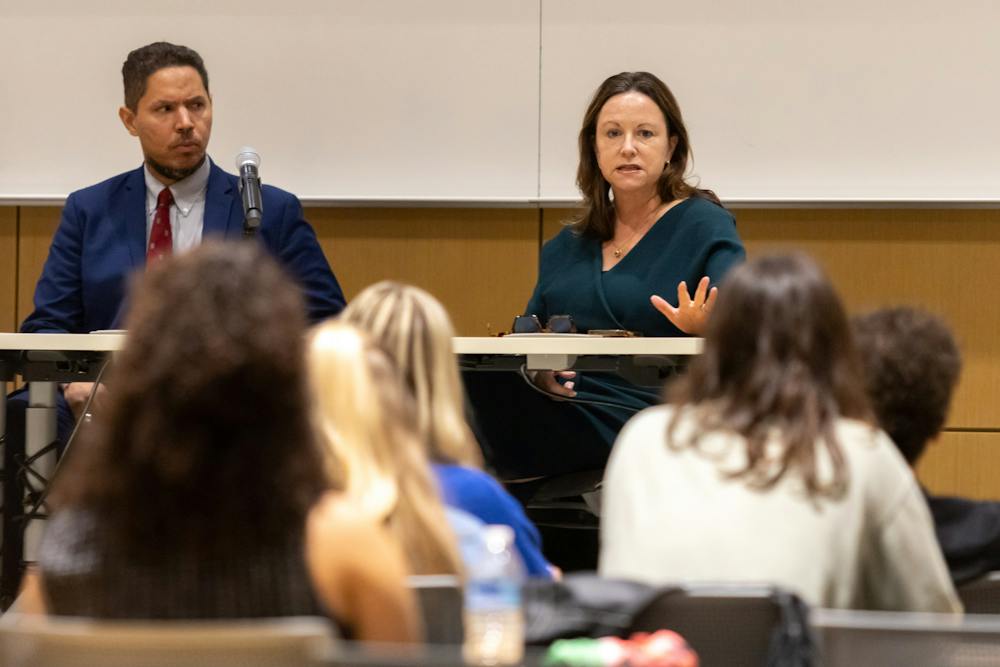
Chief Justice Megan Cavanagh and Justice Noah Hood from the Michigan Supreme Court visited Central Michigan University on Sept 30. They spoke to students about their time in the judicial branch.
Two seats on Michigan's Supreme Court will be decided in this upcoming election for eight-year terms. Cavanagh and Hood are current members of the court and are campaigning for their return. They are running against Michael D. Warren Jr., Thomas Howe, Casandra Morse-Bills and Jody White.
This event was put on by the CMU Democrats, the Women in Law Association and Phi Alpha Delta Pre-Law Fraternity. It was an opportunity for students to become aware of some of the candidates on the November ballot for this election, Kyla Stepp, political science and law professor, said.


"Knowing who is on the ballot can help students be informed," Stepp said. "The justices coming here to CMU is a great opportunity for students to ask them questions."
Chief Justice Cavanagh served on the Michigan Supreme Court since 2019 and became chief justice in 2025. She graduated from Wayne State University. After working in patent law, she practiced appellate law 16 years before joining the Michigan Supreme Court.
She said part of her goal in her current term was to improve the well-being of law students, lawyers and judges.
While on the court, she said she worked on child protective proceedings and juvenile justice and with the attorney and judicial discipline systems. She also started the Wellbeing and the Law Commission.
The justices also talked about a decision the courts made to better the well-being of people's lives. For example, the Michigan's Consumer Protection Act, which protects consumers from fraud and unfair practices, such as charging excessive prices and false advertising.
Cavanagh said that it is also important to address people's needs to create a more accessible system for people. This involves improving data infrastructure, updating court forms and self-help centers.
Justice Hood was appointed to the court in 2025 by Governor Witmer for a partial term. He studied languages and anthropology, which led him to legal anthropology and then law school.
He worked as a federal prosecutor in Toledo, served as a Wayne County Circuit Court judge and also as a Michigan Court of Appeals judge before joining the Michigan Supreme Court in 2025.
The bulk of his federal experience was gained from his time in Toledo, he said. During his time there, Hood took on the cases nobody else wanted.
"I can tell you, I would not be on the Supreme Court right now had I not gone to Toledo," Hood said.
Hood said that filling in the resource gaps in the judicial system, such as financing all courts in the state better, could address people's legal needs. He said it's also important that courts slow down when a person is in front of a judge so they can understand the court's ruling.
"It's both a success and a indictment of a catastrophic systemic failure, which is we're moving too quickly for people to understand what's happening on the most important day of their lives," Hood said.
When it comes time to vote, Cavanagh said that when someone does the straight-ticket vote to select all members from one political party, they often don't look at the non-partisan candidates.
Stepp said that it is important to vote this upcoming election, and to make sure to vote on the non-partisan part of the ballot, because the justices, who determine the state's laws, will be on there.


