Officials remain 'positive' despite enrollment trends

Central Michigan University President Neil MacKinnon sits beside Dr. Denise Williams Mallett, chair of the Board of Trustees before the first Board meeting of the year begins in Bovee University Center, on Thursday, Feb. 12, 2026. This was Chair Mallett's first meeting in her new role. (CM-Life | Cristin Coppess)
Central Michigan University is now home to 13,524 students, which is a 600 student drop from last year and around a 9,500 student drop from 2017. Despite low enrollment, Vice President of Student Recruitment and Retention, Jennifer DeHaemers, said she is optimistic about where the university stands with enrollment.
“We’re maintaining,” DeHaemers said. “Obviously we’d rather be growing, but to be at that spot is definitely a positive in the sense that we’re not continuing to decline.”
Here is how this year’s enrollment numbers look:


- Total undergraduate enrollment has dropped by 9 students.
- Total graduate enrollment has dropped by 602 students.
- Total new freshmen enrollment has decreased by 35 students.
- Total transfer students have increased by 30 students.
- Total International students has decreased by 497 students.
- Total Black, Indigenous and People of Color (BIPOC) students have increased by 70 students.
Universities across Michigan have been experiencing a decline in enrollment numbers throughout this year and last year. According to Bridge Michigan, the number of high school graduates enrolling in universities dropped from last year and other previous years.
At the beginning of this year, the university rolled out the Strategic Enrollment Management (SEM) Plan, a five year goal to increase enrollment. The plan includes four priorities and 34 initiatives that are in the midst of being implemented.
At the September Board of Trustees committee meetings, CMU President Neil MacKinnon said he was hopeful about the future of the university’s enrollment numbers because of the initiatives in the SEM plan like extending the university's free application period from August to October and the Central Career Guarantee program which promises students a job or graduate school within the first six months of graduating.
“I’m still very optimistic that we have the right plan, the right leadership with Jennifer and her team,” MacKinnon said. “There will be better days ahead.”
This year, the university received 21,432 applications, according to Robert Roe, executive director of the Academic Planning Analysis office. The current acceptance rate is 90.8%.
Within all of those applications, only 45% of interested transfer students and 9% of interested freshmen actually enrolled through CMU, DeHaemers said.
DeHaemers said this trend is typical because most high school students and those interested in transferring universities tend to apply to other universities that are not on their priority list.
“It puts a lot of noise in the system because if your counselor is saying, ‘just put them all in there,’ and you do and you get 15 acceptance letters, you really are only going to go to one institution,” she said. “And what goes into a student and family’s decision about where they’re going to end up going, it’s a lot more than just which one accepted me and that sort of thing.”
DeHaemers also pointed out some positive spots in the data.
“This would be our third year in a row that we’ve had increases in those new freshmen and transfer populations,” DeHaemers said. “That’s really good. We’re also overall up in new domestic undergrad students from Michigan, so we’ve attracted more Michigan students to the university than we had as of last year.”
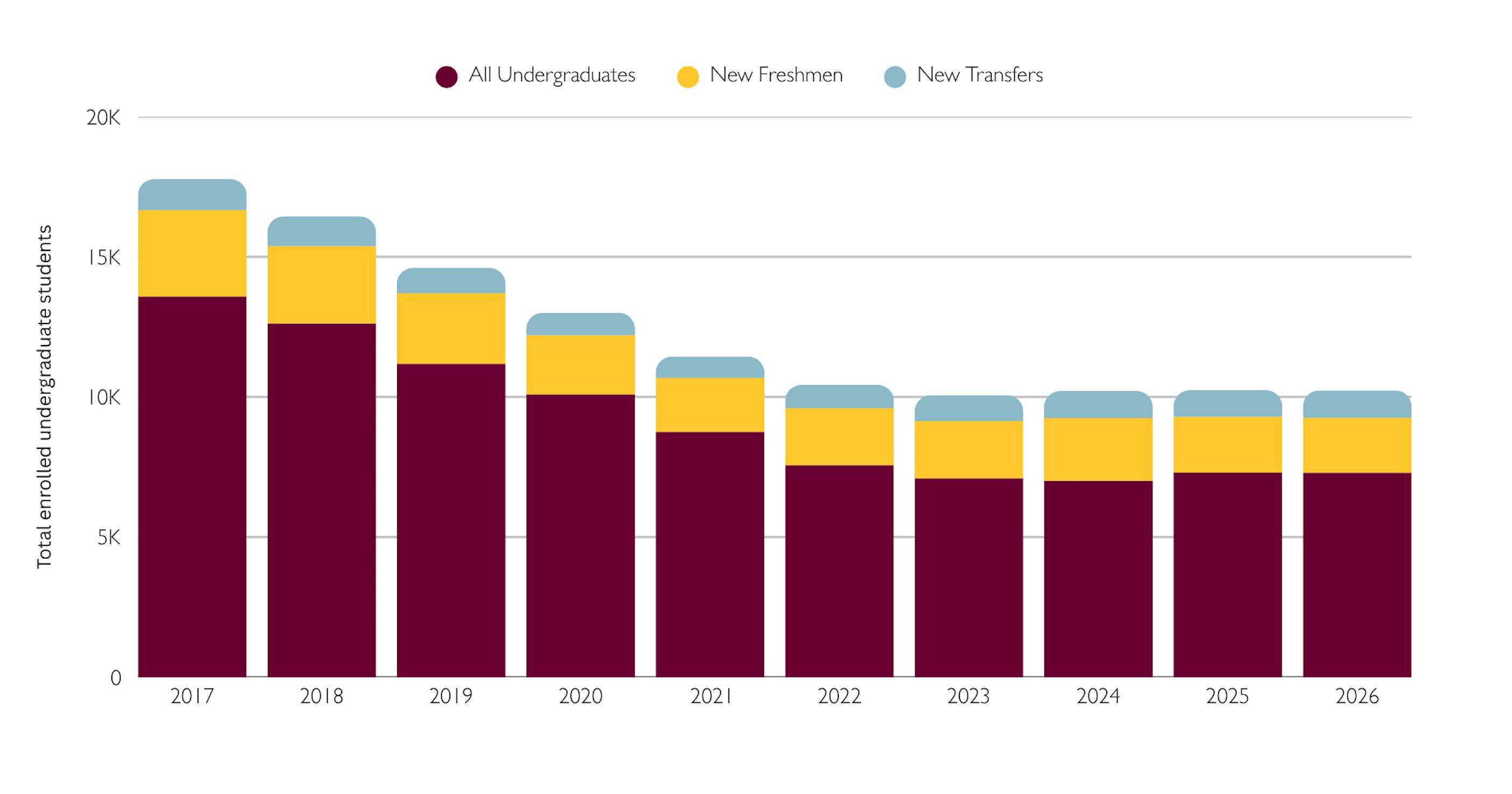
Central Michigan University's undergraduate enrollment has decreased by over 7,500 students between 2017 and 2026. (Ben Westerhof | Senior associate designer)
The international variable
CMU international enrollment dropped by 497 students from the spring to this fall semester. Three years ago, the university reached its highest international enrollment of 1,734 students.
Despite the drop in students, DeHaemers said the university thought only 50 international students would enroll, but instead 79 enrolled. However, there are currently only six students who have their visas and are expected to come in the spring of 27’.
“Now I expect that number will go up, but how much I don't know,” DeHaemers said.
There are several reasons why international enrollment has declined at CMU and universities across the U.S., DeHaemers said.
There are less opportunities for international students due to current policies under the Trump Administration. For example, some students would want to get two masters, but now they can only get one degree at each level (masters, bachelor’s and associate). They don’t have the extended time frame (an extra year) that the university typically gives students.
International admissions have been affected by several immigration policies that have slowed the process down, Dehaemers said. This has also been compounded by the increase in visa denial rates.
An I-20 is a form that proves that someone has been accepted into a university and is able to attend. Afterwards someone looking to attend an American school must meet with a consulate who does a background check to get a visa appointment.
However, there are now fewer consulates and the background checks for visas have been longer.
DeHaemers said the decline in international enrollment will also affect the cross-cultural communication interactions between students. Interaction between the locals, domestic and international students helps broaden people’s horizons.
“I think the world becoming smaller is maybe not always good, but in a lot of ways, it's good to have understanding of other people and to realize there are differences, but not as many as the similarities,” DeHaemers said.
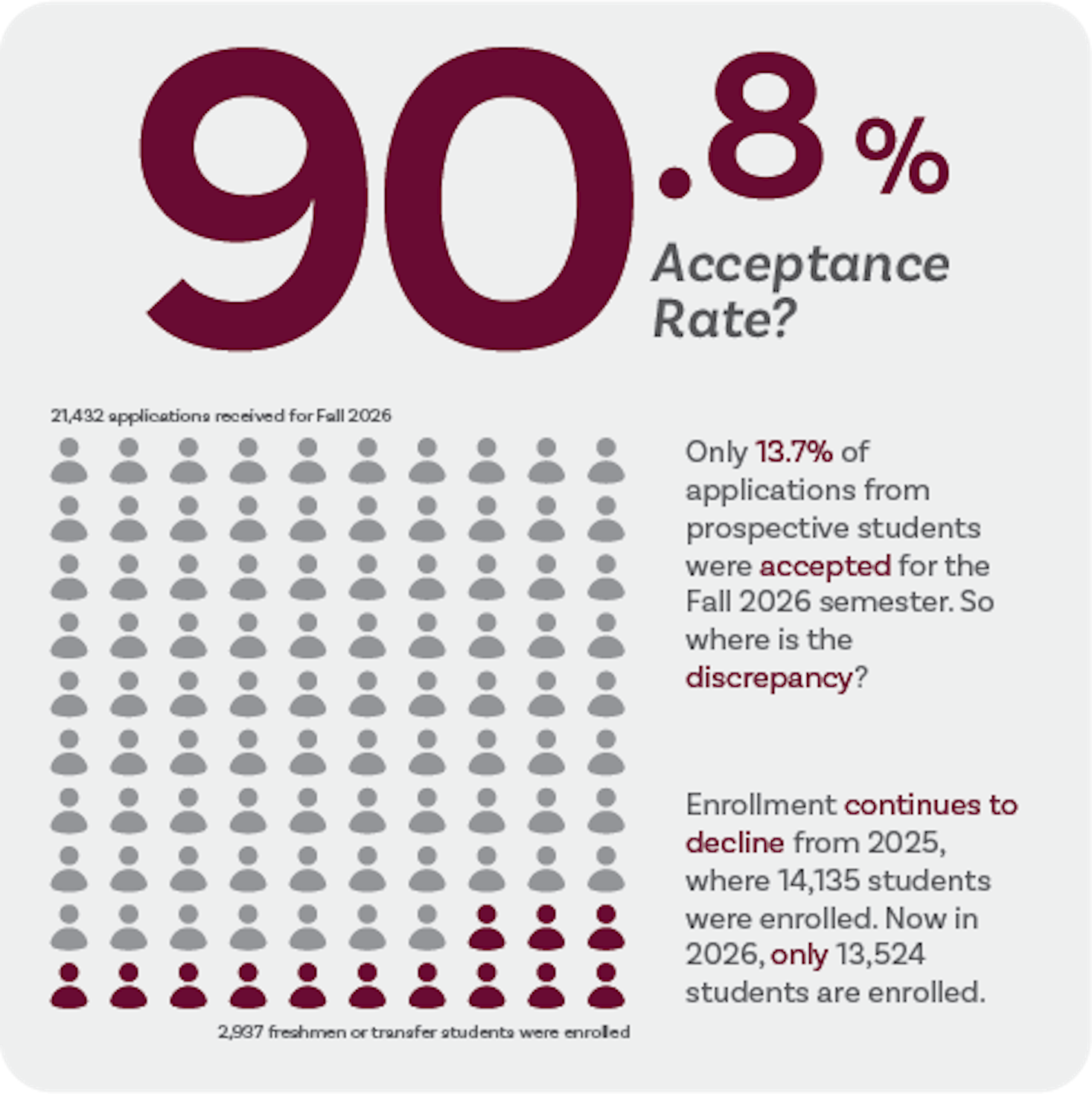
Central Michigan University had an acceptance rate of 90.8% for the 2026-27 academic year. Only 13.7% of prospective students enrolled for this year. (Ben Westerhof | Senior associate designer)
A Central (Bound) focus
There was a 3.15% increase in transfer student enrollment this year, which DeHaemers said, was something her team expected.
The university is currently partnered with Lansing Community College (LCC) through a new program called the Central Bound Program. Through this, LCC students are able to dual enroll through LCC and CMU courses.
Although this was the first semester where LCC students were able to apply for the program, the university saw a 45% increase of transfer students from LCC this semester, Trustee Sharon Heath said in the September Board of Trustees Committee meetings.
Now, the university is working with Muskegon Community and has plans with four other community colleges across the state to create more partnerships through the Central Bound Program.
But outside of transfer students, DeHaemers said her office's main focus is to still increase overall enrollment.
"We're trying to grow enrollment through all kinds, any kind of student in essence, as long as they're academically eligible to be here," DeHaemers said.
At the September Board of Trustees committee meetings, Vice Chair of the Board of Trustees Todd Regis emphasized that the effort to increase enrollment should be a university-wide goal.
“I think enhanced enrollment and student retention is so important to the future of this university,” Regis said. “Really everybody on this campus should be doing everything they can to help reinforce and to help retain and enroll new students to Central.”


